How to Reduce BOM Cost for Volume PCBA with TI/ADI/ST/Microchip Components
Table of Content
- 1. The Criticality of BOM Cost in Volume PCBA
- 2. Strategic Component Selection: Leveraging TI, ADI, ST, and Microchip
- 3. Design for Manufacturing(DFM) and Value Engineering for Cost Reduction
- 4. Supply Chain Optimization and Strategic Sourcing
- 5. Tools, Partnerships, and Lifecycle Management
- 6. PCBA BOM Cost Reduction FAQs
- 7. Summary
- Key Takeaways
1. The Criticality of BOM Cost in Volume PCBA
In the fiercely competitive electronics industry, profitability often hinges on razor-thin margins. For products manufactured at scale, the Bill of Materials(BOM) cost for Printed Circuit Board Assembly(PCBA) represents the largest single expense. Optimizing this cost is not merely a financial exercise; it’s a strategic imperative that directly impacts market competitiveness, product pricing, and ultimately, a company’s bottom line.
When producing hundreds of thousands or even millions of units, every cent saved on a component reverberates significantly across the entire production run. A mere dollar reduction in BOM cost per unit can translate into millions in savings annually. This is particularly true when dealing with high-volume PCBA, where the choice of semiconductor components from industry leaders like Texas Instruments(TI), Analog Devices(ADI), STMicroelectronics(ST), and Microchip Technology can make or break a product’s economic viability.
This article delves into actionable strategies for reducing PCBA BOM costs, focusing on intelligent component selection, leveraging the strengths of major semiconductor manufacturers, optimizing design, and employing robust supply chain practices. Our goal is to equip you with the knowledge to make informed decisions that drive substantial cost reductions without compromising quality or performance.
2. Strategic Component Selection: Leveraging TI, ADI, ST, and Microchip
The foundation of a cost-effective PCBA lies in judicious component selection. While premium components from top-tier manufacturers might seem expensive at first glance, their long-term value, reliability, and widespread availability often lead to overall system cost reductions. Here’s how to approach component selection with an eye on BOM cost for volume production, focusing on our key players:
2.1 Texas Instruments(TI): Breadth and Value
TI is renowned for its incredibly broad portfolio, encompassing everything from power management ICs to microcontrollers, analog devices, and embedded processors. For volume PCBA, TI offers several advantages:
- Wide Availability & Standard Parts:Many TI parts are industry standards, meaning they are widely stocked by distributors, reducing lead times and allowing for better pricing negotiation due to high demand.
- Value-Line Products:TI often provides “value-line” versions of their popular ICs, which may offer slightly reduced performance or features but come at a significantly lower price point, ideal for applications where every penny counts.
- Integrated Solutions:Look for highly integrated solutions(e.g., power management units with multiple rails, MCUs with integrated peripherals) that can replace several discrete components, thereby reducing part count, PCB area, and assembly costs.
For example, using a single TI power management IC that handles multiple voltage rails can eliminate numerous LDOs, switching regulators, and associated passive components, streamlining your design and reducing your overall BOM.
2.2 Analog Devices(ADI): Performance and Integration
ADI is a leader in high-performance analog, mixed-signal, and DSP ICs. While often perceived as premium, ADI also offers solutions that, when strategically chosen, can lead to BOM cost reductions:
- High Integration:ADI excels at integrating complex analog functions. Choosing a single ADI part that combines , for instance, an ADC, DAC, and amplifier can often be more cost-effective than designing with three separate, lower-cost components when considering PCB space, complexity, and assembly time.
- Reliability & Support:Their robust parts often mean fewer field failures, reducing warranty and service costs over the product’s lifecycle – an indirect but significant cost saving.
- Broad Portfolio:Beyond their high-performance flagship products, ADI also offers a range of standard signal chain components that are competitive for volume applications.
2.3 STMicroelectronics(ST): Ecosystem and Cost-Efficiency
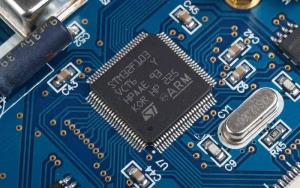
ST is a powerhouse in microcontrollers, sensors, and power semiconductors. Their STM32 series microcontrollers are ubiquitous in embedded systems and offer an excellent balance of performance, features, and cost for volume applications:
- Scalable Microcontroller Family:The STM32 ecosystem allows for easy migration across different price and performance points, ensuring you can select the most cost-effective MCU for your specific needs. Volume pricing for STM32 MCUs is highly competitive.
- Integrated Sensors:ST is a major player in MEMS sensors. Integrating ST sensors directly into your design can simplify interfacing and benefit from ST’s comprehensive sensor portfolio.
- Power Management:ST offers a strong line of power management and discrete components, providing cost-effective options for power conversion and control.
The extensive software ecosystem and community support around STM32 also reduce development costs, which, while not direct BOM, contribute to overall product cost reduction.
2.4 Microchip Technology: Embedded Prowess and Robustness
Microchip, known for its PIC microcontrollers and, more recently, its acquisition of Atmel(AVR MCUs) and Micro semi(FPGAs), is a go-to for robust, cost-effective embedded solutions:
- Cost-Effective Microcontrollers:PIC and AVR microcontrollers are highly optimized for cost and power consumption in volume applications. They are often the most economical choice for simpler control tasks.
- Comprehensive Embedded Solutions:Beyond MCUs, Microchip offers a vast array of associated components like EEPROMs, analog front-ends, and interface ICs, allowing for a single-vendor approach that can simplify procurement and potentially yield better volume pricing.
- Long-Term Availability:Microchip has a strong reputation for maintaining product availability over very long lifecycles, which is crucial for high-volume products with extended market lives, preventing costly redesigns due to End-of-Life(EOL) components.
2.5 General Component Selection Tips
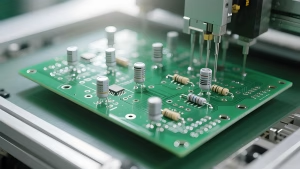
- Standardization:Wherever possible, standardize on common component families or even specific part numbers across multiple products. This aggregates purchasing volume, leading to better discounts.
- Second Sourcing:Identify pin-compatible or functional equivalents from different manufacturers. This provides supply chain flexibility and leverage in negotiations(e.g., finding alternatives for a TI op-amp from ADI or vice-versa).
- Package Selection:Smaller packages(e.g., QFN vs. TQFP, SOT-23 vs. SOIC) can reduce PCB area and overall board cost, but might slightly increase assembly complexity(though modern automated assembly handles these well). Balance cost, manufacturability, and thermal performance.
- Long-Term Availability:Prioritize components with strong lifecycle management. Components prone to early EOL can force costly redesigns and requalification processes.
3. Design for Manufacturing(DFM) and Value Engineering for Cost Reduction
Cost reduction isn’t just about what you buy; it’s also about how you design. DFM and value engineering principles are crucial for minimizing BOM and assembly costs in volume PCBA.
3.1 Consolidate and Integrate
One of the most effective strategies is to reduce the total number of components on the board. Each additional component adds to BOM cost, purchasing overhead, inventory management, and assembly complexity. Consider highly integrated solutions:
- System-on-Chip (SoC)/Highly Integrated MCUs:Instead of a separate CPU, memory, and peripheral controllers, use an SoC or a microcontroller with ample integrated flash, RAM, and peripherals(like those from TI, ST, Microchip). This reduces component count dramatically.
- Integrated Analog Front-Ends:For sensor applications, look for ADI or TI parts that combine instrumentation amplifiers, ADCs, and filters into a single package.
3.2 Optimize PCB Design
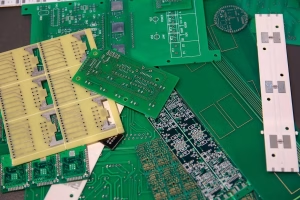
The PCB itself is a significant part of the BOM. Optimized design can lead to substantial savings:
- Minimize Layers:Each additional PCB layer increases cost. Aim for the fewest layers possible(e.g., 2-layer or 4-layer boards are typically much cheaper than 6+ layers).
- Board Size and Shape:Smaller boards use less material. Rectangular or square boards are often more cost-effective to produce and panelize than complex shapes.
- Standard Panelization:Design your board to fit standard panel sizes used by PCB manufacturers. This optimizes material utilization and reduces waste.
- Component Placement:Optimize placement for automated assembly. Minimize component types per side, ensure sufficient spacing for pick-and-place nozzles, and consider thermal management to avoid costly heat sinks.
3.3 Value Engineering
Value engineering involves systematically evaluating each component and design choice to ensure it provides necessary functionality at the lowest possible cost. This might involve:
- Performance vs. Cost:Do you really need a 24-bit ADC from ADI, or would a 16-bit ADC from TI suffice for your application? Is a high-speed ARM Cortex-M4 from ST necessary, or could a lower-cost ARM Cortex-M0 or a PIC microcontroller from Micro chip do the job? Avoid over-specifying components.
- Tolerance Review:Loosening component tolerances(e.g., 5% resistors instead of 1%) can sometimes lead to significant cost savings without impacting performance, especially for passive components.
- Connector Rationalization:Standardize on fewer connector types and sizes. Proprietary or custom connectors can be surprisingly expensive.
4. Supply Chain Optimization and Strategic Sourcing
Even with the perfect design, poor supply chain management can inflate BOM costs. Effective procurement strategies are vital for volume PCBA.
4.1 Volume Discounts and Long-Term Agreements(LTAs)
The most straightforward way to reduce unit cost for high-volume production is to leverage purchasing power. Engage directly with manufacturers like TI, ADI, ST, and Microchip, or their authorized distributors, to negotiate volume discounts. Long-Term Agreements(LTAs) commit you to purchase a certain quantity over a period, often locking in favorable pricing.
4.2 Authorized Distributors vs. Brokers
While brokers might offer lower prices on occasion, especially for hard-to-find parts, relying on them for critical components in volume production carries significant risks of counterfeit parts, inconsistent supply, and lack of manufacturer support. Prioritize authorized distributors(e.g., DigiKey, Mouser, OrinewPCB) for genuine parts, reliable supply, and access to technical support and factory warranties. They also provide better visibility into component lifecycle and obsolescence.
4.3 Forecasting Accuracy
Accurate demand forecasting is paramount. Over-ordering leads to excess inventory costs, while under-ordering can result in production delays and higher spot-market pricing. Collaborative forecasting with your sales team and key customers is essential. Utilize data from your ERP and CRM systems to improve predictions.
4.4 Inventory Management: JIT vs. Buffer Stock
Implementing Just-In-Time(JIT) inventory can minimize holding costs but requires a highly robust supply chain. For critical, long-lead-time components(especially from major semiconductor vendors), maintaining a strategic buffer stock might be a more prudent approach to mitigate supply chain disruptions, even if it incurs some holding costs. A balanced approach tailored to specific component criticality and lead times is often best.
4.5 Engage with EMS Providers Early
Your Electronics Manufacturing Services(EMS) partner has invaluable experience in procurement and DFM. Involve them early in the design process. They can provide feedback on component availability, manufacturability, and offer alternative sourcing options that can significantly reduce BOM and assembly costs. They often have stronger purchasing power due to aggregated demand across multiple clients.
| Strategy | Impact Area | Potential Savings | Considerations |
| Standardization of Parts | BOM, Inventory, Procurement | 5-15% on individual parts | Limits design flexibility slightly |
| High Integration(e.g., SoC) | BOM, PCB Area, Assembly | 10-25%(overall system) | Higher initial chip cost, design complexity |
| Volume Negotiation/LTAs | BOM, Procurement | 5-20% on high-volume parts | Requires commitment to quantities |
| DFM(PCB Layers, Size) | PCB Cost, Assembly | 10-30% on PCB manufacturing | Requires early design focus |
| Second Sourcing Strategy | BOM, Supply Risk | 5-10% through competition | Requires thorough qualification |
Factors Influencing Component Cost Reduction
5. Tools, Partnerships, and Lifecycle Management
To systematically reduce BOM costs, leveraging the right tools and fostering strategic partnerships is key.
5.1 BOM Management Software
Invest in robust BOM management software that integrates with your CAD/EDA tools and ERP system. These tools can help:
- Track component costs in real-time.
- Identify duplicate parts and suggest standardization.
- Monitor component obsolescence(EOL alerts).
- Automate compliance checks(e.g., RoHS, REACH).
5.2 Simulation and Prototyping
Utilize simulation tools(e.g., SPICE, thermal analysis) to optimize designs before physical prototyping. Catching design flaws early reduces iteration cycles and costly rework. Rapid prototyping with low-cost components for initial functional validation can also save money before committing to high-volume component purchases.
5.3 Expert Partnerships
Collaborate closely with application engineers from TI, ADI, ST, and Microchip. They possess deep product knowledge and can often recommend cost-optimized solutions or suggest alternatives you might not have considered. Their expertise can be invaluable in selecting the most cost-effective IC for your specific performance requirements. Additionally, leverage the expertise of your EMS partner for their purchasing power and DFM insights.
5.4 Component Lifecycle Management
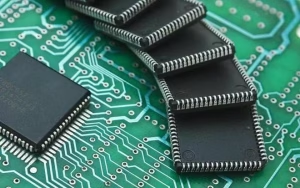
Component obsolescence is a silent killer of cost efficiency. When a critical component goes End-of-Life(EOL), it can trigger a costly redesign, requalification, and re-certification process. Implement a proactive component lifecycle management strategy:
- Monitor EOL Notices:Regularly check for EOL notices from manufacturers for all critical components, especially those from TI, ADI, ST, and Microchip, which typically have good EOL visibility.
- Last-Time Buy(LTB):Plan for Last-Time Buy opportunities for EOL components to bridge the gap until a redesign is complete or an alternative is qualified.
- Strategic Redesign:Budget and plan for proactive redesigns to incorporate newer, more readily available, and often more cost-effective components before a critical part becomes obsolete.
6. PCBA BOM Cost Reduction FAQs
Question1: How much can I realistically save on my PCBA BOM cost?
Savings vary widely depending on the initial optimization level, product complexity, and volume. However, by implementing the strategies outlined, companies often achieve 5-20% direct BOM cost reduction, with indirect savings(reduced inventory, fewer redesigns) adding even more.
Question2: Is it always cheaper to use generic components instead of brand-name parts from TI, ADI, ST, or Microchip?
Not necessarily. While generic components may have a lower unit price, brand-name parts often offer better reliability, superior performance, long-term availability, comprehensive support, and better integration options, which can lead to lower overall system costs and fewer field failures. In high volume, the security of supply and support from major vendors can outweigh slight unit price differences.
Question3: What is the single most effective strategy for reducing BOM cost?
While many strategies contribute, choosing widely available, standard components with multiple suppliers and avoiding over-specification during the design phase generally offers the greatest impact on BOM cost for volume PCBA.
Question4: How can I ensure component availability from major suppliers like TI or ST?
Engage early with your suppliers or EMS partner, utilize official distributor networks, consider long-term agreements(LTAs), and always design with qualified second sources for critical components. Monitor product lifecycle status proactively.
Question5: What role does my EMS partner play in BOM cost reduction?
Your EMS partner is crucial. They have aggregated purchasing power, established relationships with distributors and manufacturers, and deep expertise in DFM. Engaging them early allows them to suggest cost-effective component alternatives, optimize the PCB layout for manufacturability, and secure better pricing through their supply chain.
Question6: How can I protect my BOM from volatile component prices?
Strategic sourcing, long-term agreements(LTAs) with fixed pricing, accurate demand forecasting, and maintaining a strategic buffer stock for critical components can help mitigate price volatility. Diversifying your supply base with second-sourced components also provides flexibility.
Question7: What is Early Supplier Engagement(ESE)?
ESE involves bringing component suppliers and your manufacturing partner into the design process at its earliest stages. Their expertise can help identify cost-saving component alternatives, resolve potential manufacturing issues, and optimize the supply chain before the design is finalized.
Question8: How do tariffs affect BOM cost reduction strategies?
Tariffs can significantly impact component costs, especially for parts sourced internationally. Strategies include exploring alternative sourcing regions not subject to tariffs, optimizing supply chains to minimize dutiable value , and engaging with suppliers to understand their tariff pass-through policies.
7. Summary
Reducing BOM cost for volume PCBA is a multi-faceted endeavor that requires a holistic approach, blending intelligent design choices with savvy procurement strategies. By leveraging the strengths of industry giants like TI, ADI, ST, and Microchip–focusing on their comprehensive portfolios, integrated solutions, and robust support–manufacturers can make informed component selections that yield significant savings.
Coupling this with rigorous Design for Manufacturing(DFM) principles, proactive value engineering, and optimized supply chain management, companies can build a resilient and cost-effective production model. Ultimately, sustainable BOM cost reduction is about strategic thinking, collaborative partnerships, and a relentless pursuit of efficiency at every stage of the product lifecycle.
Key Takeaways
- Prioritize component selection from major vendors like TI, ADI, ST, and Microchip, seeking integrated, value-line, or standard parts for volume applications.
- Implement Design for Manufacturing(DFM) and value engineering to reduce component count, optimize PCB layout, and right-size component specifications.
- Optimize your supply chain through volume negotiations, Long-Term Agreements(LTAs), accurate forecasting, and strong relationships with authorized distributors.
- Engage your EMS partner and manufacturer application engineers early in the design process to leverage their expertise and purchasing power.
- Proactively manage component lifecycles to avoid costly redesigns due to obsolescence.
OrinewPCB has focused as a one-stop PCB assembly manufacturer from PCB Manufacturing to Electronic Components Sourcing to PCB Assembly to Test to Program IC for more than 14 Years with reliable quality and fastest delivery for global clients.