NRE Costs in PCB Assembly: Setup, Reuse & Reorder Checklist
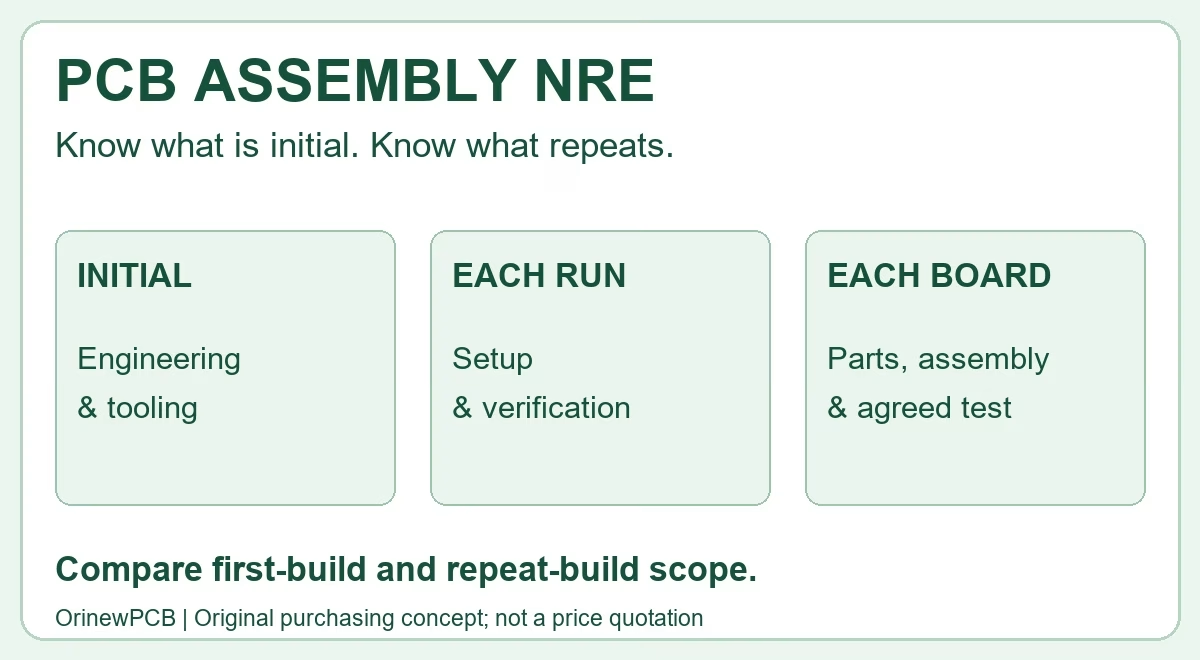
Table of Content
- 1. NRE, run setup and unit cost are different questions
- 2. Review the deliverables behind the engineering charge
- 3. Ask what actually survives into the repeat order
- 4. Compare first and repeat orders with a transparent calculation
- 5. Use this checklist before approving the quotation
- 6. Reduce avoidable preparation work without weakening quality
- 7. What to send OrinewPCB for an initial and repeat-build review
- PCB assembly NRE and setup-cost FAQ
PCB ASSEMBLY PROCUREMENT · SMALL BATCH & HIGH MIX
Quick answer: NRE means non-recurring engineering: work needed to prepare a specific product or manufacturing release, rather than a charge for making each board. In a PCB assembly quotation, separate that initial work from setup repeated for each production run and recurring per-board work. Ask what each fee delivers, which revisions and variants it covers, what can be reused, and what changes trigger another charge. A line labeled “setup/NRE” does not answer those questions by itself.
A small PCBA order can have a modest component bill yet still need stencil preparation, manufacturing programs and a usable test arrangement. The right purchasing question is not simply whether the first order has a setup fee. It is what you receive for that fee, and what you will pay again on the next build.
This guide helps hardware engineers, product managers and purchasing teams review NRE and repeat-order conditions for small-to-medium, high-mix turnkey PCB assembly. For the wider material and production cost picture, use our PCB assembly cost breakdown. This article focuses specifically on initial engineering, reusable tooling and repeat-run charges.
Preparing a build now? Send your files, quantities and variants for a turnkey PCBA and BOM review, and ask for initial and repeat-order costs to be identified separately.
1. NRE, run setup and unit cost are different questions
In product development, non-recurring engineering can include the engineering effort needed to develop, test and bring a product into production. An assembly supplier’s quotation may cover a much narrower manufacturing-preparation scope. Do not assume that an assembly NRE line includes circuit design, firmware development, compliance testing or product qualification.
Use three categories when comparing quotations:
| Cost category | What it may cover | Question to settle |
|---|---|---|
| Initial engineering and tooling | Product-specific data preparation, stencil creation, fixture development or test-software development, where included in the agreed scope. | What deliverable is being created, for which release, and under what reuse conditions? |
| Production-run setup | Preparing and verifying a line or station for a particular run, including loading, configuration and changeover work as quoted. | Does this charge recur for each order, lot, side, variant or production release? |
| Recurring unit work | Bare boards, fitted components, assembly, programming, agreed inspection/test and packing for each unit. | What is included per delivered acceptable board, and what is excluded? |
Commercial labels vary. Some suppliers combine these categories, include preparation in a unit price or waive a separate fee under stated conditions. Ask for the scope and recurrence rule rather than judging the offer by the label alone. A reusable program does not mean a production line stays configured between your orders.
2. Review the deliverables behind the engineering charge
An actionable NRE line connects a task to an output and an acceptance point. “Engineering: included” is harder to manage than “manufacturing data reviewed against assembly A100 revision B; unresolved items returned for approval before release.” The latter wording identifies a boundary without implying that every design problem has been solved.
- Data preparation: identify the released PCB package, assembly drawing, placement data, BOM and variants used to create manufacturing outputs. Clarify whether design edits are included or need separate approval.
- Stencil: identify the relevant board/panel and side, the approved paste-aperture design, and any process assumptions. The stencil belongs to a controlled manufacturing configuration, not just a product nickname.
- Inspection and assembly programs: clarify which variants and processes the preparation covers, and which changes require review or revalidation.
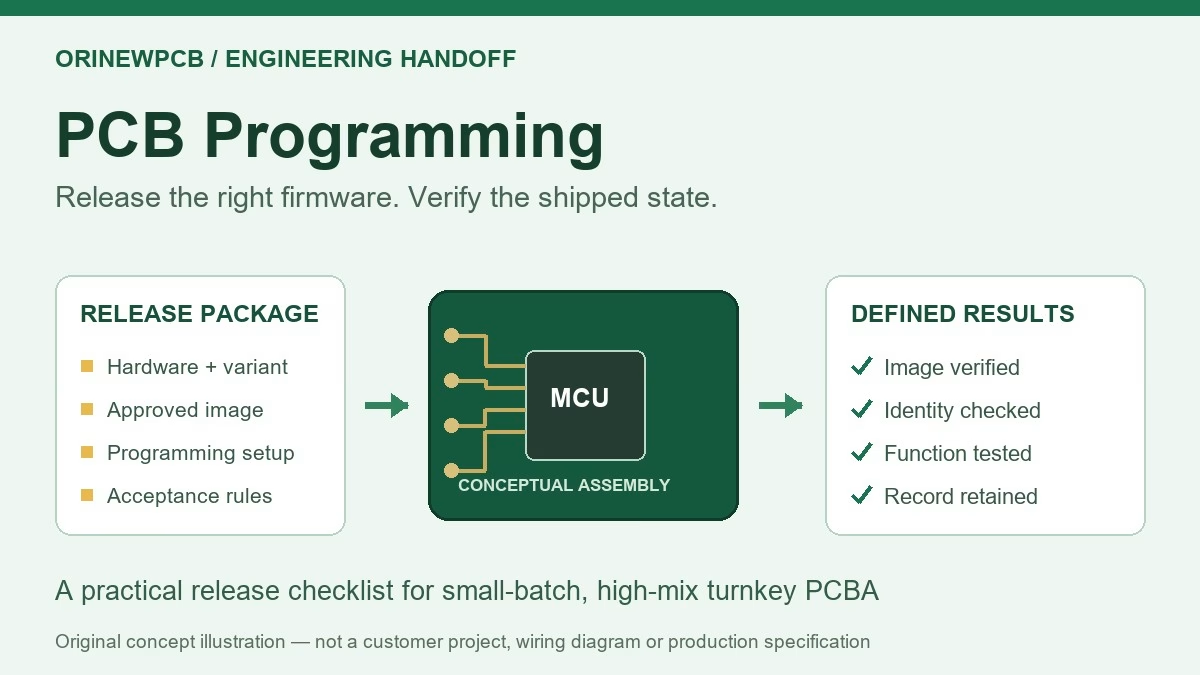
- Programming setup: define the target device, approved image/configuration, access method and required verification. Loading a supplied image is different from writing or debugging the product’s firmware.
- Test development: distinguish developing a fixture or test sequence from running that sequence on every delivered board.
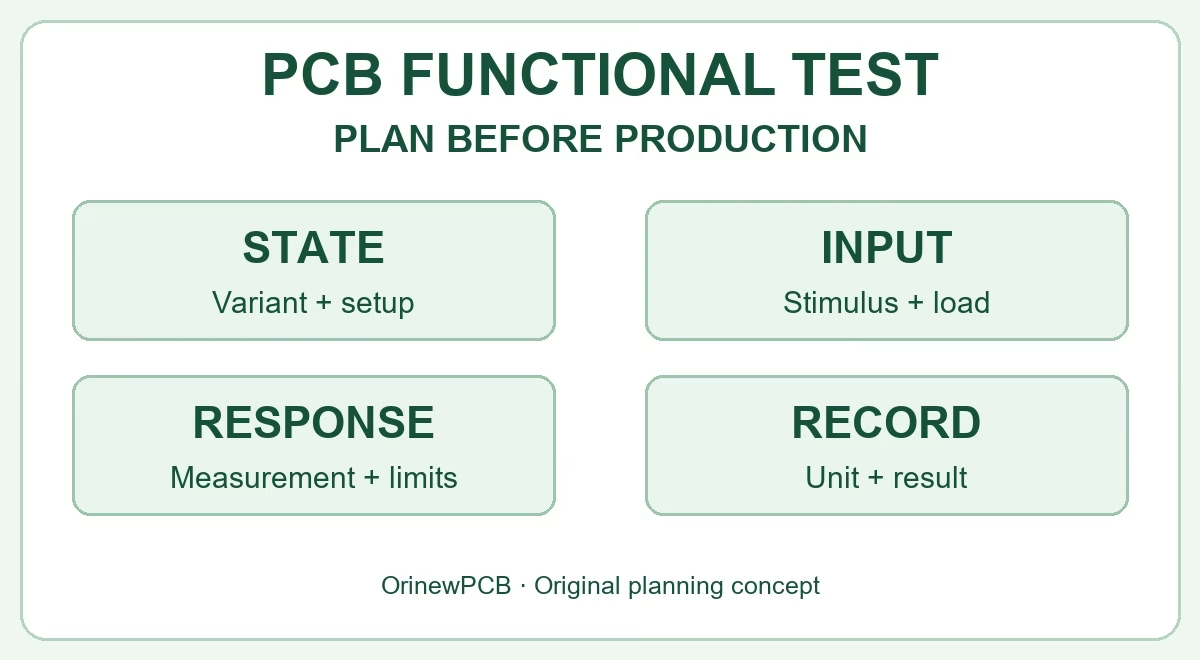
For programming, correct device selection, connection, power and access conditions matter; a firmware file alone is not the complete station handoff. Our PCB programming release checklist lists the engineering inputs. For test-development work, provide the functional test plan and identify who approves the station and acceptance limits.
3. Ask what actually survives into the repeat order
Reuse should be tied to an identifiable, compatible release and usable tooling. An unchanged product name does not establish that the stencil, fixture, software and production instructions are still suitable.
| Item | Possible reuse basis | Reason to review again |
|---|---|---|
| Paste stencil | Approved aperture design, board/panel identity, side and process remain suitable; stencil is available and serviceable. | Changed pads, panel arrangement, paste requirements, physical condition or incompatible printer setup. |
| Assembly or inspection program | Controlled data, packages, placement, orientation and variant instructions remain applicable. | Changed BOM/placement, a package substitution, new variant or changed equipment/process. |
| Programming arrangement | Device, interface, wiring, approved images and required verification remain compatible. | New device/image/security configuration or different access and power requirements. |
| Functional fixture and test software | Mechanical fit, connections, approved limits and tested functions remain applicable; station readiness is checked. | Changed connectors, test points, firmware behavior, functions, loads or required evidence. |
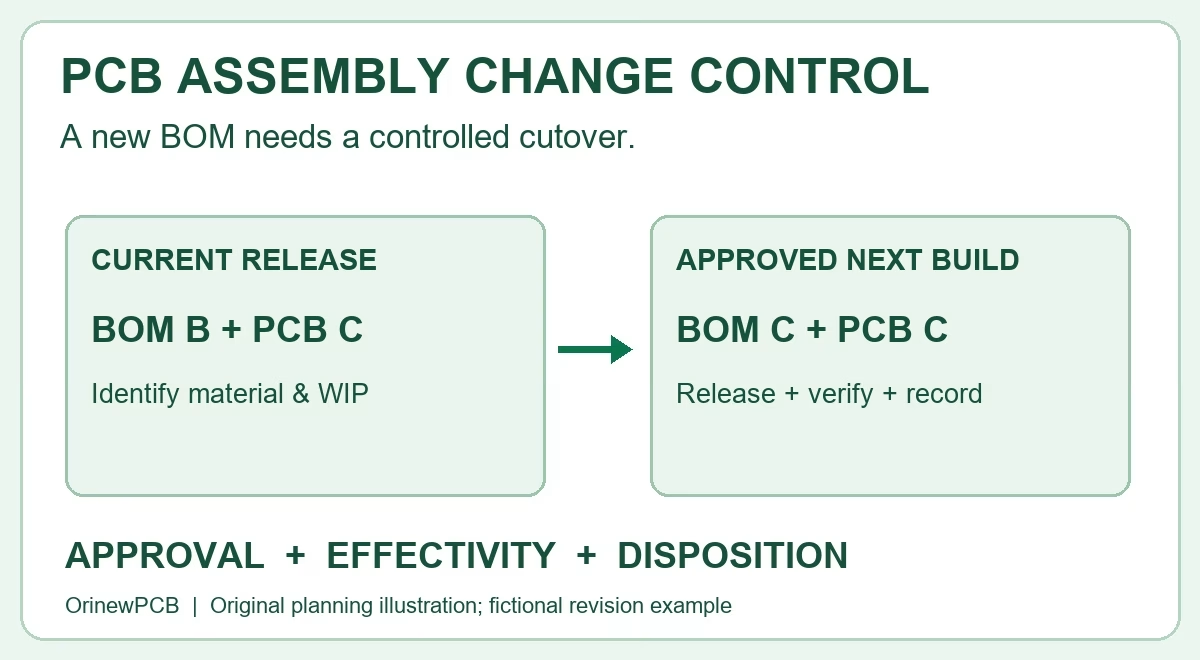
This is a review checklist, not a rule that every change requires completely new tooling. Ask the supplier to identify what can be retained, what needs an update and how that decision affects cost and release timing. Use a controlled PCB assembly engineering change when the approved configuration changes.
Before placing the first order, also agree the practical stewardship of reusable items: identifier and revision, storage location and period, condition checks, maintenance/replacement, and what files or physical items can be returned or transferred. Paying an NRE invoice should not be treated as a substitute for a written agreement about ownership, access and reuse.
4. Compare first and repeat orders with a transparent calculation
A useful comparison keeps initial engineering, run setup and per-board work visible:
Illustrative order total = initial engineering/tooling applicable to this order + run setup applicable to this order + (delivered quantity × recurring unit cost) + separately agreed charges.
Allocated cost per delivered board = that order total ÷ delivered quantity.
The example below uses fictional planning numbers in USD. It is not an OrinewPCB price, industry benchmark or quotation. It assumes the same approved product and scope, no new engineering on the repeat order, and a constant unit cost solely to show the arithmetic. Freight, taxes and other exclusions are not included.
| Planning scenario | Initial / run / unit inputs | Order total | Allocated per board |
|---|---|---|---|
| First build: 50 boards | $600 initial + $150 run setup + 50 × $30 | $2,250 | $45.00 |
| Repeat: 50 boards | $0 new engineering + $150 run setup + 50 × $30 | $1,650 | $33.00 |
| First build: 200 boards | $600 initial + $150 run setup + 200 × $30 | $6,750 | $33.75 |
The calculation demonstrates cost allocation, not a reason to buy more boards than needed. Material availability, unit-price breaks, cash tied up in stock, revision risk and the delivery plan can change the purchasing decision. For a high-mix order, compare each variant’s quantities and preparation needs; do not divide one setup fee across all variants unless the quoted scope actually permits it.
If a supplier spreads NRE into the unit price, ask for the quantity or commitment assumed and what happens on a repeat order. Avoid counting the same tooling cost both as a separate line and inside the unit price. Compare total payable amounts for the same scope, not only the displayed assembly price.
5. Use this checklist before approving the quotation
- Freeze the comparison baseline. Give every supplier the same PCB revision, BOM/variant, quantity, shipped state and required quality/test scope.
- Separate the three cost categories. Ask which items are initial, which repeat per run and which apply to every board.
- Name the deliverables. Record the stencil, fixture, manufacturing-data or test-software output, applicable revision and required approval.
- State the reuse conditions. Identify what is retained, for how long, and when an update or replacement is chargeable.
- Price a realistic repeat scenario. Request the same revision and quantity again, plus any likely alternate quantity or variant. Mark forecasts separately from committed orders.
- Expose exclusions. Clarify design corrections, development/debugging, unusual materials, extra inspections, retests after an approved change, storage and shipment charges.
- Link payments to an agreed scope. Define any review, delivery or approval milestones without assuming that “NRE paid” means the product is production-ready.
- Confirm the release and delivery dependencies. Identify pending approvals, components, tooling and test inputs before treating a requested date as a confirmed shipment date.
Record unresolved questions in the quotation review. A missing answer is an open scope item, not automatically a free service. Equally, a separate engineering line is not evidence of an unreasonable charge; assess the work and deliverables it represents.
6. Reduce avoidable preparation work without weakening quality
The most useful opportunities usually come from a stable, complete handoff. Align fabrication files, assembly drawings and BOM variants before release. Identify approved alternatives before a shortage forces a package change. Supply the firmware and test requirements early enough for the supplier to review station needs with the assembly quote.
For low-volume PCB assembly, ask whether a proposed test approach suits the quantity, access and required coverage. A lower tooling investment is only useful if the agreed checks still address the product’s requirements. Bare-board electrical testing, optical inspection, structural electrical testing and functional testing answer different questions; they should not be removed from scope simply to make quotations look comparable.
For multiple variants, provide a clear fitted/DNP matrix and discuss shared tooling where compatible. Do not assume that all variants using the same bare PCB can share every program or test sequence. If an engineering change is likely soon, compare the cost of a limited pilot with the risk of committing to tooling or materials that may become unsuitable.
These steps help suppliers quote the intended job. They do not guarantee a particular saving, price or lead time.
7. What to send OrinewPCB for an initial and repeat-build review
OrinewPCB provides one-stop PCB assembly, combining PCB manufacturing, component sourcing and assembly, with particular strengths in small-to-medium, high-mix builds. We review the complete build scope so that purchasing and engineering can discuss material, manufacturing and delivery requirements together.
- PCB fabrication outputs and specification; assembly drawing and placement data.
- Exact manufacturer part numbers, quantities, fitted/DNP variants and approved alternatives.
- Initial quantity, likely repeat quantities and timing; distinguish forecasts from commitments.
- Required shipped state: assembled, programmed, tested, coated or integrated, as applicable.
- Programming/test requirements, fixture information and any existing reusable tooling.
- Required inspection evidence, traceability and acceptance requirements.
- Requested delivery date and destination, plus any missing files or unresolved decisions.
Our component policy is to supply and assemble with 100% new, original and genuine electronic components. Cooperation with component manufacturers and distributors supports project-specific sourcing reviews; actual availability, price and delivery are confirmed against your BOM and order scope. Sourcing-only inquiries can start with our electronic components catalog.
We emphasize quality through our nine-stage PCBA quality workflow and 100% flying-probe testing of the bare PCBs we manufacture. Those are distinct scopes: a bare-board electrical result does not replace an agreed assembled-board functional test. State the project-specific inspection, test and records you need. More brand information is available at OrinewPCB.
Know the first-build scope—and the repeat-build conditions
Send your PCB files, BOM variants, quantities and test requirements. Ask us to review genuine component sourcing, assembly, initial preparation, recurring work and the delivery plan in one coordinated turnkey quotation.
Request a Turnkey PCBA & BOM Review
Include any existing tooling and anticipated revisions. Final pricing, reuse terms and lead time depend on the reviewed files and agreed scope.
PCB assembly NRE and setup-cost FAQ
What does NRE mean in a PCB assembly quote?
It means non-recurring engineering. In an assembly quotation it usually identifies agreed product-specific preparation or development work. Ask for the exact deliverables and applicable release; the label alone does not mean that circuit design, firmware development or all testing is included.
Will I pay NRE again when I reorder the same board?
Not necessarily, but confirm the written reuse conditions. Existing suitable tooling and engineering outputs may be reusable, while line or station setup can still recur. Revisions, damaged or unavailable tooling, new variants or changed test requirements may need additional review and work.
Is a stencil charge the same as a setup fee?
No. A stencil is a physical manufacturing tool with an applicable design and process. Run setup is work to prepare production. A quote may bundle them, so ask which item is retained and which charge applies again to later runs.
Does paying for a test fixture include testing every PCBA?
Only if the agreed quotation says so. Fixture development, station validation, production test execution and later maintenance are different activities. Identify required coverage, per-unit work and retained results separately.
Can several PCBA variants share the same NRE?
Some preparation may be shared when the design and process are compatible. Different fitted parts, programming, connectors or test coverage can require separate outputs or validation. Provide the variant matrix and ask which shared and variant-specific work is included.
How can I compare a quote with no separate NRE against one with NRE?
Use the same released files, quantities and scope. Compare the total first order and an explicit repeat-order scenario, including exclusions and any commitments. An initial cost can be bundled into unit pricing; a separate fee can cover useful reusable work. Neither label alone establishes the better offer.
Related Posts
ORINEWPCB · PROJECT SUPPORT
Contact Us
Discuss your PCB assembly project with our team.
FREE QUOTE
Plan your turnkey PCBA build.
Share your quantity and requirements. Add Gerber files and a BOM when ready.
Files are optional for an initial discussion. Include any assembly, sourcing or testing requirements in your message.