Approved Manufacturer List for PCBA: BOM Alternatives Checklist
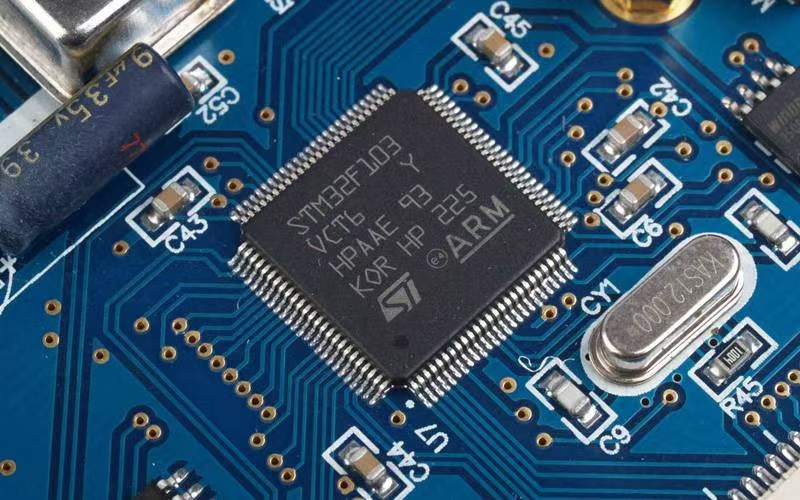
Table of Content
- 1. AML, AVL and BOM: agree what each list controls
- 2. What should an approved manufacturer list contain?
- 3. Review an alternate beyond package and nominal value
- 4. Use a controlled substitution workflow
- 5. A practical approval-record example
- 6. What to send for an approval-ready turnkey quote
- 7. Approved manufacturer list FAQ
An approved manufacturer list (AML) maps an internal BOM item to the exact manufacturer part numbers your engineering team has approved. For turnkey PCB assembly, send that list with the board revision, approval status, permitted purchasing sources and substitution rules. A distributor’s cross-reference suggestion or an available component is a candidate for review; it is not permission to change the build.
This guide answers a specific procurement question: how do you let a PCBA supplier source available parts without losing control of the design? The practical answer is to separate component approval, source approval and production release. Engineers retain control of electrical and mechanical suitability; buyers have a defined sourcing envelope; the assembler knows which configuration it may actually build.
Preparing an order? Send your BOM and approved-parts list for a turnkey PCBA review. Include quantity and the revision you want quoted.
1. AML, AVL and BOM: agree what each list controls
The BOM describes the assembly: internal item numbers, reference designators, quantities and the parts to populate. An AML connects an internal item to one or more approved manufacturer parts. A source list identifies the organizations from which purchasing is permitted. In practice, companies use AVL, ASL and AML differently, so define these terms in your order documents instead of relying on the abbreviation alone.
| Record | Question it answers | What it does not establish |
|---|---|---|
| Released assembly BOM | What is fitted to this board revision and variant, and at which reference designators? | A generic description alone does not identify every acceptable manufacturer part. |
| Approved manufacturer list | Which exact manufacturer and orderable part numbers may satisfy this internal item? | It does not approve every seller offering that part or every application of it. |
| Approved source list | Which suppliers or distribution channels may provide the required part? | A permitted supplier cannot independently approve a different electrical component. |
| Build authorization | Which released BOM, approved alternatives and exceptions apply to this purchase order or lot? | A prototype-only approval does not automatically authorize future production. |
On a phone, swipe each table horizontally. Keyboard users can focus a table region and use the arrow keys.
For the broader manufacturing service boundary, see turnkey PCB assembly. This article focuses on approval control rather than general BOM creation or cost reduction.
2. What should an approved manufacturer list contain?
Make the file usable by the person placing the purchase order and the person verifying the assembly. A row that says “10 kΩ, 0603, any brand” may leave tolerance, rated power, temperature behavior and the package convention unresolved. Keep the complete orderable MPN, including relevant suffixes, and explain any separately permitted packaging variants.
- Identity: internal item number, manufacturer name and full approved MPN. Keep the manufacturer’s number separate from a distributor’s stock code.
- Assembly context: board identifier, BOM revision, populated variant, reference designators and quantity per board. Keep do-not-populate positions explicit.
- Approval scope: approved, candidate, restricted or obsolete status; permitted product/revision; any prototype-only or lot-specific restriction.
- Technical evidence: datasheet revision, comparison record, qualification or test reference, and unresolved conditions.
- Authority: approver, approval date, change-control reference and the person responsible for disposition of exceptions.
- Sourcing conditions: permitted channels, packaging requirements, requested traceability records and any customer-specific date-code or handling requirement.
One internal item may have multiple approved MPNs if the design owner has qualified them for that use. That does not mean all reference designators sharing the same nominal value must allow the same alternatives. A timing resistor and a pull-up resistor can have different constraints even when both are described as 10 kΩ.
3. Review an alternate beyond package and nominal value
A cross-reference tool is useful for finding candidates. Its categories can distinguish a close replacement from a pin-compatible device with different parameters or a part with only similar functionality. Start with that comparison, then check the requirements of your actual circuit. “Equivalent” must have a defined scope.
| Review area | Questions to resolve | Evidence to retain |
|---|---|---|
| Mechanical and assembly | Do footprint, pin mapping, body height, terminal geometry, polarity and recommended land pattern fit the design and process? | Package drawings, pin comparison and any assembly-process review. |
| Electrical operating limits | Are supply range, input/output levels, accuracy, load capability and relevant temperature limits suitable? Do not use absolute maximum ratings as normal operating conditions. | Applicable datasheet limits and circuit requirements under stated conditions. |
| Dynamic and analog behavior | Could startup, stability, noise, timing, switching or transient behavior affect the application? | Analysis and targeted bench tests with defined pass/fail criteria. |
| Firmware and interfaces | Are device IDs, register behavior, programming, boot conditions and communication timing compatible? | Firmware version, configuration and interface-test results. |
| Materials and handling | Do finish, soldering restrictions, moisture sensitivity and supplied packaging fit the proposed process? | Manufacturer handling guidance and relevant material documentation. |
| Product requirements | Does the change affect required environmental performance, customer approval, safety or regulatory evidence? | Design-owner review and any required product-level evaluation. |
For a genuine component, authenticity and application suitability are separate questions. A new, original part can still be wrong for the circuit. Likewise, an AOI image cannot prove all electrical characteristics or establish purchasing provenance.
Example: two capacitors with the same headline rating
Suppose a designer considers another ceramic capacitor with the same nominal capacitance, voltage rating and package size. For high-dielectric-constant MLCCs, capacitance can change under applied DC voltage. Review the exact candidate’s bias and temperature characteristics, tolerance and the circuit’s effective-capacitance requirement. The matching headline description alone is insufficient.
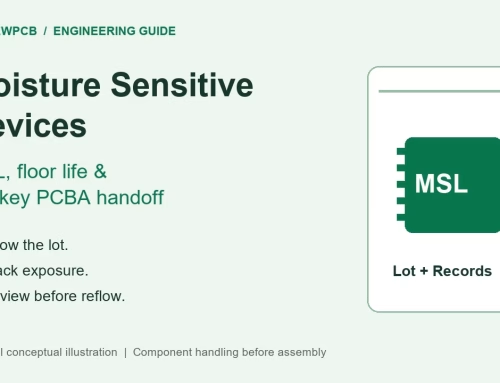
This is an illustrative review scenario, not a proposed interchange between specific MPNs. No performance curve, acceptance threshold or savings estimate is implied. For handling considerations after a part is selected, use our MSL and floor-life handoff guide.
4. Use a controlled substitution workflow
- Identify the shortage or commercial issue. Record the original MPN, required quantity, build revision and the reason an alternative is being considered. Availability information should include when it was checked.
- Propose a candidate separately. Keep the original released part visible. Attach the candidate’s full MPN and a difference list; do not silently replace a BOM cell.
- Assign the engineering review. The design owner determines the necessary checks and who can authorize the change. Purchasing can compare commercial terms while approval remains pending.
- Run the required evaluation. Agree any sample build, inspection, electrical or functional testing before treating the candidate as production-approved.
- Record the disposition. Approve for the intended scope, approve with restrictions, reject, or leave pending. Record the specific product, revision, quantity or lot restriction.
- Release the purchasing and build instruction. Update the controlled AML/BOM or issue a traceable exception. Ensure the quote, purchase order, assembly data and test documents refer to the same approved configuration.
- Close the loop. Confirm what was actually purchased and fitted, retain the agreed evidence, and decide whether later orders need a renewed approval.
Separately authorizing sample procurement can be reasonable while qualification is pending, but distinguish that limited action from permission to populate production boards. The written instruction should say what may be bought, how it is segregated and who accepts the financial commitment.
5. A practical approval-record example
The following fields illustrate a useful record. Identifiers are fictional placeholders, not real component recommendations or a customer case.
Assembly: Controller Board, Rev C, Variant V1
Affected item: CAP-017 at C12 and C13
Original: manufacturer and full released MPN
Candidate: manufacturer and full proposed MPN
Reason: original part unavailable for the requested build window
Evidence required: package comparison, effective-capacitance review and the circuit tests defined by the engineer
Status: candidate pending; no production substitution authorized
Final disposition: record the decision, approver, date, test reference and permitted board revision or lot.
If the evaluation later approves only a pilot lot, retain that restriction in the production instruction. Do not convert “pilot accepted” into an unrestricted approved alternative merely because the first boards powered on.
6. What to send for an approval-ready turnkey quote
Give the assembler enough information to quote both the released build and any clearly identified alternatives. Request that unresolved items remain visible instead of being hidden behind a single total price.
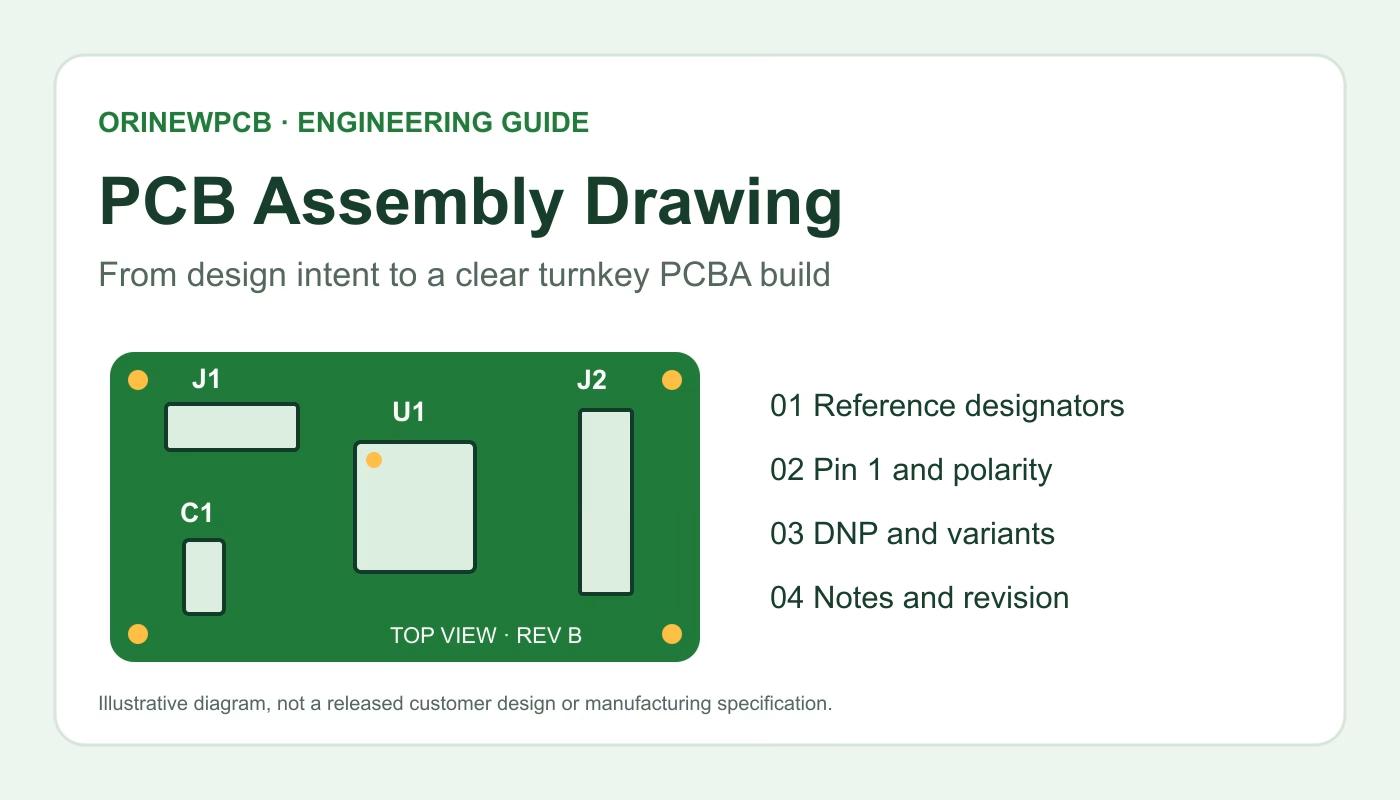
- Released BOM, board revision, variants, DNP positions, Gerber/manufacturing files, placement data and assembly drawing.
- Approved manufacturer/MPN list, pending candidates and a clear “no substitution without written approval” instruction where applicable.
- Prototype and production quantities, target schedule and permitted delivery splits. These are requested requirements, not confirmed availability.
- Purchasing-source, traceability and supplied-material requirements; identify any customer-provided parts separately.
- Functional or electrical test requirements, firmware, fixtures and acceptance criteria; identify additional qualification work needed for alternatives.
- Commercial assumptions such as minimum buy quantities, excess material ownership, quote validity and any non-cancellable commitments to be reviewed before ordering.
For each unresolved BOM line, a useful supplier response identifies the exact offered MPN, approval status, available purchasing option, quantity assumption and the action required from the design owner. A quotation based on a candidate should be marked conditional until the necessary approvals are complete.
Keep sourcing flexibility and design control together
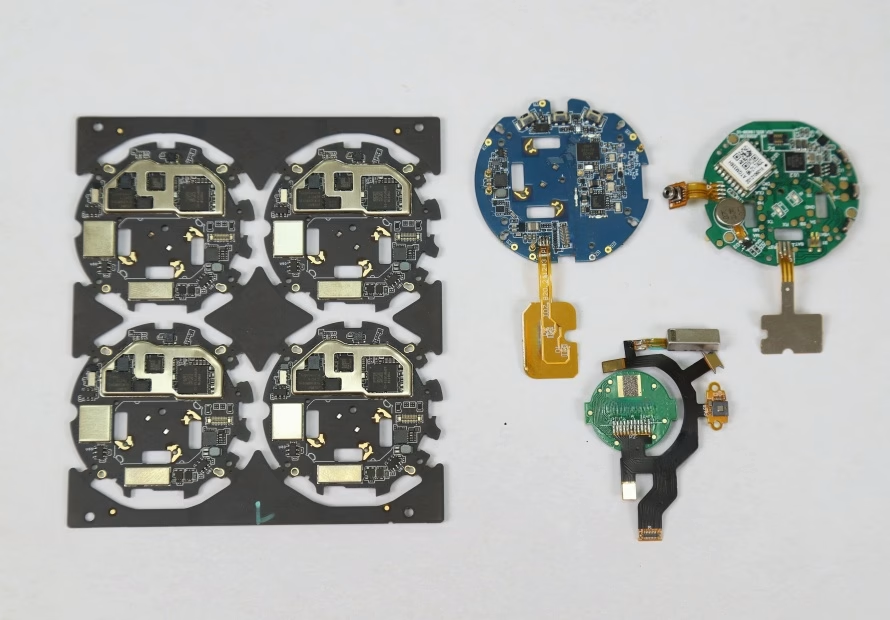
OrinewPCB supports turnkey PCB assembly, combining PCB fabrication, component procurement and assembly with the inspection or testing agreed for your project. Our policy is to supply and assemble with 100% new, original genuine electronic components. Exact MPNs, alternatives, source requirements and project documentation should be confirmed before purchasing and production.
Send your released BOM, AML and quantity. Ask us to highlight shortages and proposed alternatives separately so your engineering team can make the approval decision. Price, stock and delivery are confirmed for the specific quotation.
Request a Turnkey PCBA & BOM Review
Need materials only? See electronic component sourcing. For the brand’s manufacturing service overview, visit OrinewPCB assembly services.
7. Approved manufacturer list FAQ
What is the difference between a BOM and an AML?
The BOM describes the assembly’s items, quantities and placement context. The AML identifies approved manufacturer parts that can satisfy an internal item within a defined scope. They can be separate controlled files or linked records, provided the revision and approval relationships are clear.
Is an approved vendor list the same as an approved manufacturer list?
Not necessarily. A vendor list often controls purchasing sources, while an AML controls manufacturer part choices. Terminology varies between companies and software systems. State whether your list approves the exact MPN, the seller, or both.
Can the assembler substitute a pin-compatible part?
Only within the customer’s documented authorization. Matching pins does not establish identical electrical behavior, software compatibility or product-level suitability. Submit a candidate with its differences for the required engineering approval.
Can I put multiple approved MPNs on one BOM line?
Yes, if your control system clearly identifies each approved choice, applicable restrictions and the relationship to the internal item. Avoid ambiguous descriptions such as “or equivalent” without stating who approves equivalence and what limits apply.
Does new and original mean an alternative is suitable?
No. Authenticity describes the material’s identity and condition. Suitability depends on the design, operating conditions, package, manufacturing process and product requirements. Review both sourcing evidence and engineering compatibility.
Does a successful prototype approve a part for all future orders?
No. Approval applies to the recorded scope and evidence. A prototype-only decision may require additional qualification or a new release for production, another board revision or different operating conditions.
What should I send if I do not have an AML yet?
Start with a released BOM containing manufacturer names, full MPNs, reference designators, quantities and variants. Identify items that must not change and ask the supplier to list proposed alternatives separately. Your design owner can then establish a controlled approval record before substitution.
Related Posts
ORINEWPCB · PROJECT SUPPORT
Contact Us
Discuss your PCB assembly project with our team.
FREE QUOTE
Plan your turnkey PCBA build.
Share your quantity and requirements. Add Gerber files and a BOM when ready.
Files are optional for an initial discussion. Include any assembly, sourcing or testing requirements in your message.