
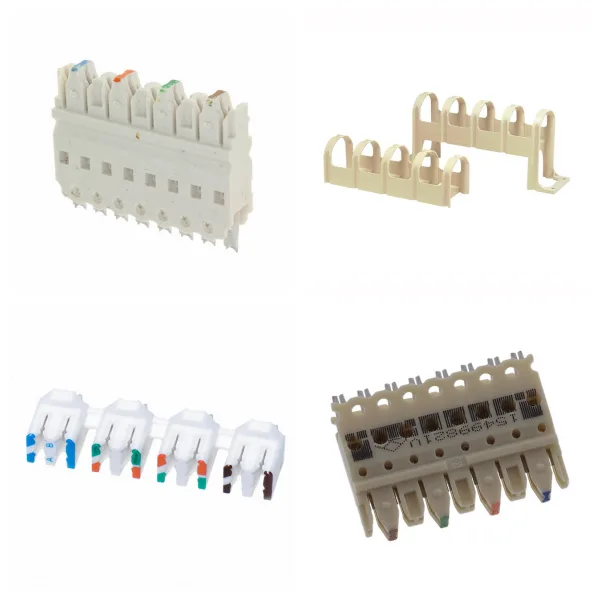
<h1> Modular Connector Wiring Blocks Accessories </h1> <p> Modular connector wiring block accessories add features and functions to wiring blocks such as cable management, clips, plugs, connecting blocks, jumpers, label holders, marking caps and punchdown blocks. They are selected by manufacturer series, color, mounting type and dielectric status. </p> <p>
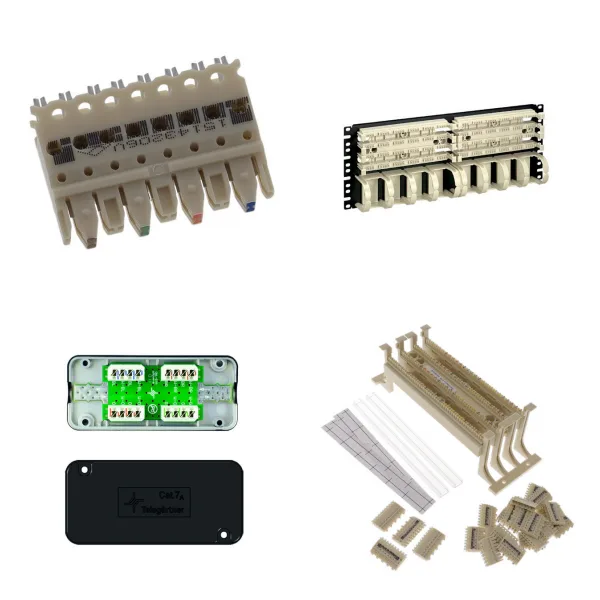
<h1> Modular Connector Wiring Blocks </h1> <p> Modular connector wiring blocks are wiring solutions designed for rack, wall, cable, junction box, and frame mounting options, allowing for multiple wire pairs to be connected without having to strip off the insulation before making a connection. Commonly referred to as punch down connectors, they are selected by wire pair capacity, dimension, mounting features such as legs, panels or screw holes, as well as additional features such as lacing straps, label holders, mounting hardware, and shielding. </p> <p>
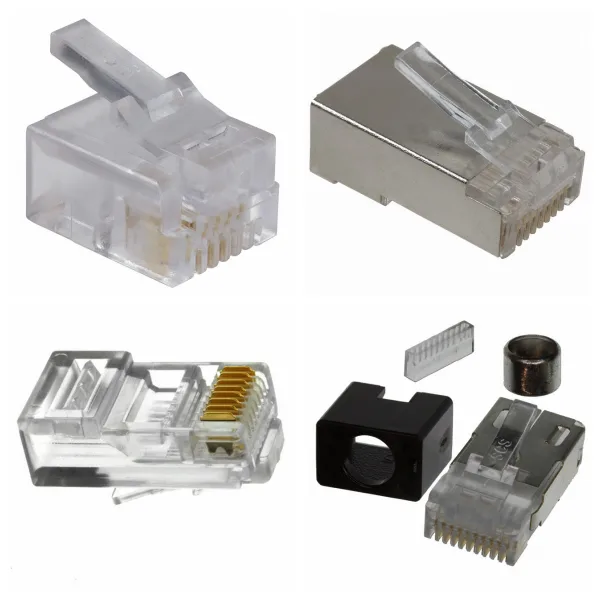
<h1> Modular Connector Plugs </h1> <p> Modular connectors are a series of standardized interconnect products commonly used in wired information and telecommunications networks. Those in this family are plugs; the component of a mated connector pair which is typically affixed to a cable in this interconnect system, and which are distinguished among themselves principally by the number of contact positions available; and the number thereof in which contacts are present. </p> <p>
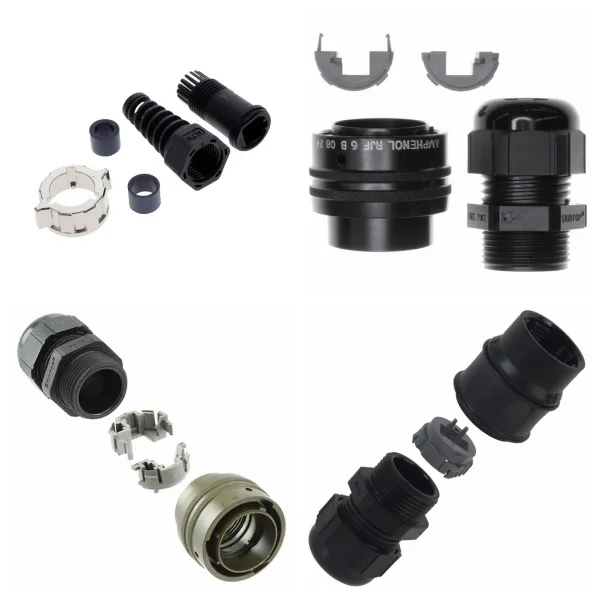
<h1> Modular Connector Plug Housings </h1> <p> Modular Connector, Plug Housings are designed to accept and protect modular plugs for prewired RJ11 Cord set, prewired RJ45 Cord set, and Hybrids, with mounting types for free hanging or panel mount. The fastening types for the Plug Housings are Bayonet lock, Latch holder, Latch lock, Lever lock, Locking ramp, Push-Pull, Reverse Bayonet, and Threaded. </p> <p>
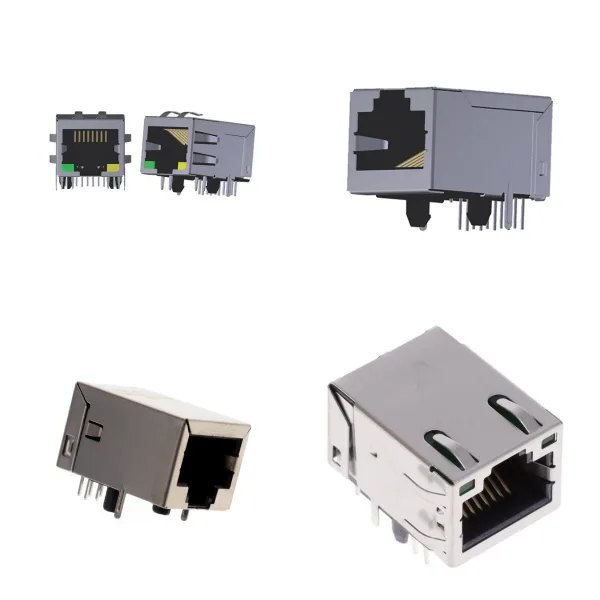
<h1> Modular Connector Jacks With Magnetics </h1> <p> The RJ45 connector—short for Registered Jack 45—is the most widely used interface for Ethernet networking, found in devices ranging from home routers to industrial switches. It uses an 8P8C (8 Position, 8 Contact) configuration standardized by ANSI/TIA-1096-A, with typical pinouts following T-568A or T-568B wiring schemes. While similar in appearance to the smaller RJ11 telephone connector, RJ45 supports more conductors and higher data rates, making it the standard for LAN transmission across Cat5e, Cat6, and Cat6a cabling. These jacks support high-speed Ethernet protocols defined by IEEE 802.3, including 10/100/1000Base-T and multi-gigabit applications. When integrated with magnetics—meaning the inclusion of built-in transformers and common-mode chokes—RJ45 jacks provide enhanced signal conditioning, isolation, and EMI (electromagnetic interference) suppression, which are essential for reliable, standards-compliant Ethernet communication. </p> <p>   </p> <p> Choosing an RJ45 jack with integrated magnetics offers several key advantages over non-magnetic versions. First and foremost, they eliminate the need for external magnetics on the PCB, saving valuable board space and simplifying layout—especially important in compact or high-density designs. These magnetics provide galvanic isolation (typically 1500 Vrms or higher) between the device and the network, protecting sensitive circuits from voltage transients and ground loops. They also improve signal integrity, especially at higher transmission speeds or over longer cable runs, by filtering noise and compensating for impedance mismatches. In applications supporting PoE (Power over Ethernet), jacks with integrated magnetics ensure compatibility with IEEE 802.3af, at, or bt standards, delivering power safely alongside data. </p> <p>
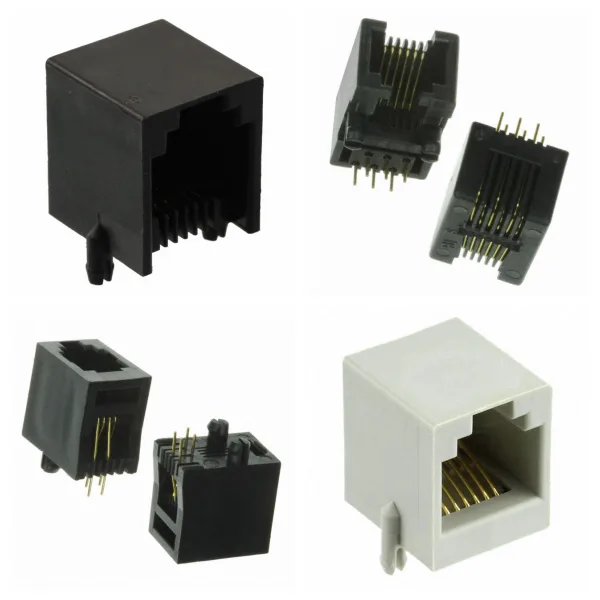
<h1> Modular Connector Jacks </h1> <p> Modular connectors are a series of standardized interconnect products commonly used in wired information and telecommunications networks. Those in this family are receptacles which do not incorporate any magnetic components such as transformers, which are necessary for applications such as Ethernet communications. Plugs and receptacles/jacks which do integrate commonly needed magnetic components are catalogued separately. </p> <p>
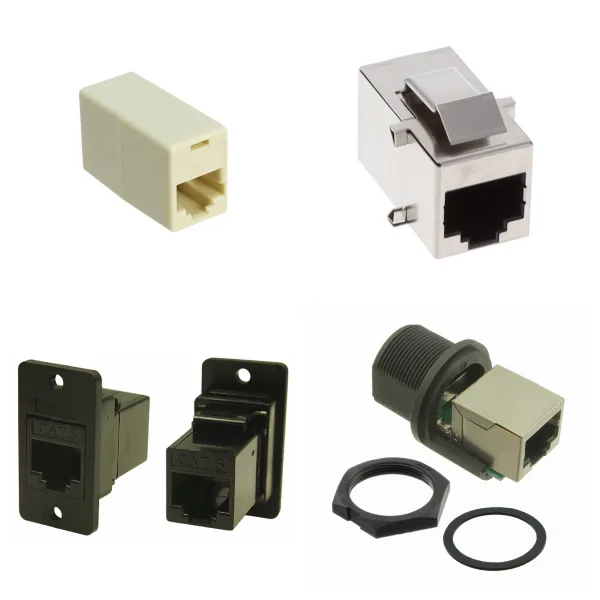
<h1> Modular Connector Adapters </h1> <p> Modular Connector Adapters are used to convert from one Modular Connector style to Modular style whether it is mounted by Flange, Brackets, Front side nut, Rear side nut, or Panel mount. Examples include Jacks 4p4c (RJ9, RJ10, RJ22), 6p4c (RJ11, RJ14), 6p6c (RJ11), 8p8c (RJ45), 10p8c, Plugs 4p4c (RJ9, RJ10, RJ22), 6p4c (RJ11, RJ14), 6p6c (RJ11), 8p8c (RJ45), or PCB. Ratings include Cat5, Cat5e, Cat6, and Cat6e. </p> <p>
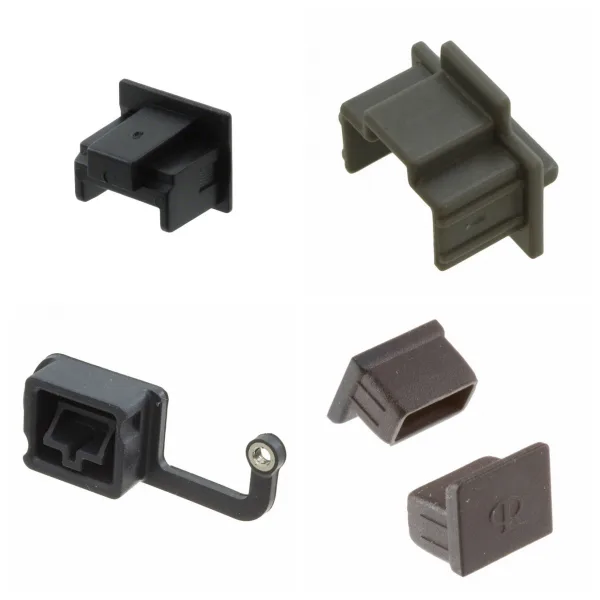
<h1> Modular Connector Accessories </h1> <p> Modular connectors are a series of standardized interconnect products commonly used in wired information and telecommunications networks. Accessory products for such connectors include items such as backshells, caps, covers, seals, mounting and fixation hardware, protective devices, and a variety of other items ancillary to or supportive of their use, either as commonly encountered or in modified form to facilitate their use in unconventional situations. </p> <p>

Modular Connectors

Modular Connectors are a type of highly standardized, flexibly configurable interconnection device in electronic engineering, which is widely used in data transmission, signal processing, power supply, and other fields. Its core feature is to achieve multifunctional integration and high-density layout through modular design.


1. What are the Core Features of Modular Connectors?

1) ‌Structure and Design Flexibility‌

Adopting a modular combination, it supports the integration of different transmission types (such as power, signal, data) in the same connector, significantly saving installation space and improving system integration.


Physical dimensions are standardized, and common specifications include 10mm×10mm, 15mm×15mm, etc. At the same time, the number and arrangement of pins can be customized according to needs.


2) ‌Performance Requirements‌

Mechanical Performance‌: Focus on plug-in and pull-out force (the standard needs to be moderate to ensure reliability), mechanical life (number of plug-in and pull-out times), and contact retention (to prevent the terminal from falling off).


‌Electrical Performance‌: Emphasize low contact resistance (milliohm level) and insulation resistance (typical value is above 100MΩ), support high-frequency signal transmission (such as Cat.6A standard) and high current load (such as 1.5A/125V).

‌Environmental Adaptability‌: It must meet the temperature range (-20°C to 70°C) and vibration and corrosion resistance requirements.


3) ‌Manufacturing and Assembly Optimization‌

Modular design supports automation and high-speed manufacturing, reducing manual errors. For example, the floating design can compensate for PCB mounting errors and reduce the impact of lateral loads on connectors.


Optimization of contact materials and shell materials (such as phosphor bronze contacts, PBT plastic shells) improves durability and signal stability.


2. What are the Types of Modular Connectors?‌

‌Board-side Connector‌: It is used for interconnection between circuit boards and supports SMT or DIP installation methods. It is commonly used in computers and industrial control equipment.

‌High-frequency Connector‌: Such as SMA, BNC, etc., suitable for RF signals and high-speed data transmission scenarios (such as communication base stations, measuring instruments).

‌Multi-functional Integrated Connector‌: Such as Han-Modular domino module, which can integrate power, data, and pneumatic interfaces at the same time, and is used in complex systems such as packaging equipment and injection molding machinery.


3. What are Modular Connectors Used for?‌

‌Industrial Control‌: HARTING brand Han-Modular Domino modules support Cat.6A data transmission standards and are used in conveyor systems and control cabinets.

‌Communication Equipment‌: For example, RJ45 modular connectors (8P8C design) are used for Ethernet interfaces and meet the UL 94 V-0 flame retardant rating.


4. Standardization and Specifications of Modular Connectors

‌Interface Definition‌: Clearly define pin layout, electrical characteristics, and signal transmission protocols (such as the MCIO standard defines pin isolation for data transmission and power distribution).

‌Environmental Certification‌: Mainstream products comply with the RoHS directive and use lead-free soldering processes.

‌Industry Compatibility‌: Some connectors are compatible with DIN standards to ensure interoperability with existing equipment.


5. Typical Manufacturers and Products of Modular Connectors

Manufacturer/Brand

Representative Products

Core Features

Application Areas

HARTING

Han-Modular Domino

Integrated power/signal/data, Cat.6A transmission

Industrial Automation

TE Connectivity

TM13R Series

On-board installation, 500V withstand voltage, 4-contact design

Communication Equipment

Molex

MCIO Series

High-density layout, supports 10Gbps high-speed signal

Server/Data Center


Through modular design, standardized interfaces, and diversified configurations, Modular Connectors provide reliable and flexible connection solutions for electronic systems, supporting the high performance and miniaturization trend of modern electronic devices.
