A Guide to Electronic Component Identification: From Beginner to Expert

Table of Content
- 1. Resistors: The “Chubby” Components with Color Codes
- 2.Capacitors: The Shape-Shifting “Energy Storage Experts”
- 3.Integrated Circuits: The Precision “Multi-Legged Experts”
- 4. Diodes and Transistors: The Directional “Current Guardians”
- 5. Surface-Mount Components: The Miniaturized “Modern Technology”
- 6. Other Common Components: The “Supporting Cast” of the Circuit World
- 7. Practical Identification Tips
- 8. Common Mistakes and How to Avoid Them
- 9. The Path from Beginner to Expert
- 10. Conclusion
Deciphering the “Morse Code” on components allows you to master circuit boards with ease.
For those new to the electronics industry, facing the dense and varied electronic components on a circuit board can often feel overwhelming—like watching a silent “component beauty pageant.” Don’t worry! Today, we’ll discuss how to easily identify these little guys, helping you transition from an electronics novice to an identification pro!
1. Resistors: The “Chubby” Components with Color Codes
1.1 The Fashionistas of the Resistor World
Resistors are arguably the most common components in the circuit world. They are usually short and stout, resembling little chubby figures adorned with colorful rings. These rings aren’t for fashion—they represent a code indicating the resistance value.
Interestingly, these color rings act like the resistor’s “ID card,” containing all its information. Each color corresponds to a number: black is 0, brown is 1, red is 2, orange is 3, yellow is 4, green is 5, blue is 6, purple is 7, gray is 8, and white is 9. Gold and silver represent tolerance ranges: gold ±5%, silver ±10%.
1.2 My First “Resistor Explosion”
I remember a funny mistake I made as a beginner. I misread brown-black-red-gold as black-brown-red-gold. The moment I powered the circuit, there was a “pop,” and the resistor emitted a puff of smoke, meeting a heroic end—and putting on a “smoke show” for me. So, reading color codes correctly is crucial! It’s like reading the instructions before taking medicine; otherwise, the consequences can be serious.
1.3 Practical Identification Tips
Here’s a quick tip: The last ring is usually gold or silver, indicating the tolerance. The second-to-last ring is the multiplier, showing how many zeros to add after the first two digits. For example, brown-black-red-gold means 10 followed by two zeros, resulting in 1000 ohms.
2.Capacitors: The Shape-Shifting “Energy Storage Experts”
2.1 The Capacitor Family’s “Fashion Show”
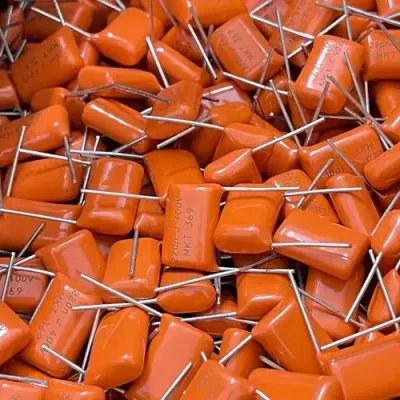
The capacitor family comes in all shapes and sizes, like a daily “fashion show”: upright cylindrical ones resembling tiny barrels, flat disc-shaped ones like coins, and miniature surface-mount types that look like sesame seeds. Each capacitor has its own characteristics and uses, just like different tools for different jobs.
2.2 Caution! Capacitors Can “Throw a Tantrum”
Electrolytic capacitors require special attention. They are clearly marked with positive and negative poles. If connected incorrectly, they might go “bang” and explode, catching you off guard. It’s like bathing a cat—if you do it wrong, it will definitely throw a tantrum.
In contrast, ceramic disc capacitors are much gentler. They only have printed numeric codes that need interpretation. For example, “104” means 10 followed by four zeros, or 100,000 picofarads (0.1 microfarads).
2.3 Capacitors’ “Superpower”
Capacitors have an amazing ability—storing electrical energy. They act like tiny batteries, charging and discharging quickly. This makes them essential in circuits for tasks like smoothing voltage and filtering noise. Without capacitors, many electronic devices wouldn’t function properly.
3.Integrated Circuits: The Precision “Multi-Legged Experts”

3.1 The “Top Students” of the Chip World
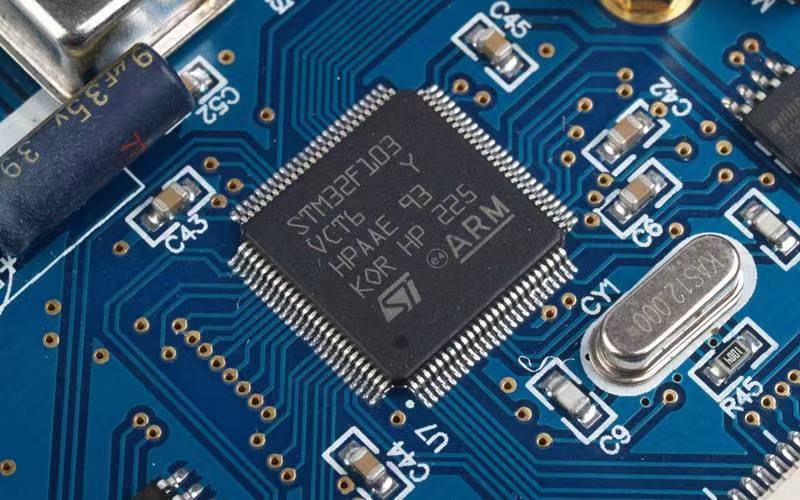
Integrated circuits, commonly known as chips, are the top students among components. They usually have two rows of densely packed pins, neatly arranged like a centipede’s legs—as if the chip is wearing “hundred-footed shoes.”
Each pin has a unique function: some supply power, some ground the circuit, and others handle input/output signals. It’s like a team where each member has a specific role to accomplish the task.
3.2 Inserting Chips Requires More Care Than Embroidery
Inserting chips requires extreme caution. If inserted incorrectly, they might not work or could be permanently damaged. Focus intently during insertion—it requires more precision than embroidery! A friend once inserted a chip backwards, ruining the entire circuit board and losing hundreds of dollars. He was so upset he couldn’t sleep for three days.
3.3 Reading the Chip’s “ID Card”
Chips are printed with model codes, like our ID numbers. These codes help us find information about their functions and parameters. For example, the NE555 is a timer chip, and the LM358 is an operational amplifier. Memorizing common chip models can speed up identification.
4. Diodes and Transistors: The Directional “Current Guardians”
4.1 The “Check Valves” of the Electronics World
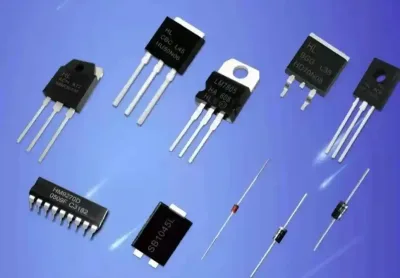
Diodes act like check valves in the electronics world, allowing current to flow in only one direction. They resemble tadpoles, with a clear head (anode) and tail (cathode). A silver ring on their black body indicates the cathode.
If installed backwards, current cannot pass—like a one-way revolving door. Light-emitting diodes (LEDs) make this even more obvious: if connected incorrectly, they won’t light up, as if sulking.
4.2 Transistors: Amplifiers of Electronic Signals
Transistors are the “heart” of electronic circuits, amplifying weak electrical signals. They have three pins: emitter, base, and collector. Each plays a specific role, working together like a well-coordinated basketball team.
The key to identifying transistors is understanding their pin configurations. Different models may have different pin orders, so always check the datasheet before use to avoid errors.
5. Surface-Mount Components: The Miniaturized “Modern Technology”
5.1 Small Size, Big Power
As circuit boards shrink, surface-mount components have become increasingly popular. These components are as small as grains of rice and as thin as paper, densely arranged on circuit boards like stars in the night sky—or an “electronic carpet.”
Surface-mount resistors typically use three-digit codes: the first two digits are significant figures, and the third is the multiplier. For example, “102” means 10 followed by two zeros, or 1000 ohms. Surface-mount capacitors usually don’t display their values and require instruments for measurement.
5.2 Soldering Requires Sharp Eyes and Steady Hands
Soldering these tiny components demands sharp eyes and steady hands. The slightest mistake can cause short circuits or cold joints—truly, “a slight move affecting the whole situation.” Use magnifying tools and anti-static tweezers, handling them with the care of micro-sculpture art.
6. Other Common Components: The “Supporting Cast” of the Circuit World

6.1 Inductors: The “Traffic Police” for AC
Inductors act like “traffic police” for alternating current, resisting changes in current flow. They may be coiled or surface-mounted, often without clear markings, requiring instruments to measure their parameters.
6.2 Crystal Oscillators: The “Heartbeat Generators” of Circuits
Crystal oscillators provide precise clock signals to circuits, giving them a “heartbeat.” Without them, devices like phones and computers wouldn’t function. They usually come in small metal cases labeled with their frequency.
6.3 Connectors: The “Bridges” of Circuits
Connectors act like “bridges” in circuits, linking different boards or cables. They come in various shapes: single-row, double-row, circular, rectangular, etc. Pay close attention to pin definitions and arrangements when identifying them.
7. Practical Identification Tips
7.1 Tools Make the Job Easier
To identify components quickly and accurately, use tools like multimeters (for measuring resistance, capacitance, and diode polarity) and transistor testers (which automatically identify component types and parameters).
7.2 Leverage Online Resources
The internet is a treasure trove of information. If you encounter an unfamiliar component, take a photo or describe its features to search for answers. Many electronics forums have helpful enthusiasts ready to assist.
7.3 Build Your Own Component Library
Beginners should create a component library, categorizing common components and labeling their parameters and characteristics. This not only makes them easy to access but also deepens your understanding through organization.
8. Common Mistakes and How to Avoid Them
8.1 Don’t Judge Components by Their Appearance
Some components look similar but function differently, like Zener diodes vs. regular diodes, or ceramic capacitors vs. surface-mount resistors. Relying solely on appearance can lead to errors.
8.2 Don’t Ignore Component Parameters
Identifying the component type isn’t enough—pay attention to specific parameters. For example, resistors with different values serve different purposes, and capacitors with different voltage ratings suit different applications.
8.3 Don’t Underestimate Electrostatic Discharge (ESD)
Many components, like MOSFETs and ICs, are sensitive to static electricity. Always take anti-static measures when handling them to avoid unintentional damage.
9. The Path from Beginner to Expert
9.1 Practice Makes Perfect
Identifying components is like making friends: you might not remember them at first, but with repeated exposure, you’ll recognize them instantly. Experienced technicians can identify a component’s model, specs, and the use with just a glance—all thanks to years of practice.
Dismantling old electronics is a great way to practice. It’s like “dissecting a sparrow”—you’ll gain hands-on experience with real-world applications.
9.2 Stay Curious and Keep Learning
Electronics technology evolves rapidly, with new components and innovations emerging constantly. Stay curious by subscribing to electronics magazines or websites to keep up with industry trends.
9.3 Grow Through Practice
Theory and practice go hand in hand. Once you can identify components, try designing and building small circuits, like LED flashers or mini amplifiers. The problems you solve along the way will accelerate your progress.
10. Conclusion
Identifying electronic components is the foundation of electronics, just like learning characters is the foundation of reading. Though it may seem challenging at first, with the right methods and persistence, you’ll soon find it enjoyable and rewarding.
Remember, every electronics master started by learning their first resistor and capacitor. With continuous learning and practice, you too can become an expert at component identification, navigating the electronics world with ease!
Stay curious and exploratory. The world of electronics is like a vast treasure trove, waiting for you to uncover its mysteries. The thrill of successfully identifying an unfamiliar component or matching a circuit diagram to a physical part is like solving a puzzle—deeply satisfying.
Start your component identification journey today! Soon enough, you’ll be able to effortlessly recognize every component on a circuit board, becoming a true electronics enthusiast!
Related Posts
ORINEWPCB · PROJECT SUPPORT
Contact Us
Discuss your PCB assembly project with our team.
FREE QUOTE
Plan your turnkey PCBA build.
Share your quantity and requirements. Add Gerber files and a BOM when ready.
Files are optional for an initial discussion. Include any assembly, sourcing or testing requirements in your message.