A Complete Guide to Avoiding Pitfalls in Component Procurement: Identifying Authentic, New Surplus, Refurbished, and Counterfeit Parts

Table of Content
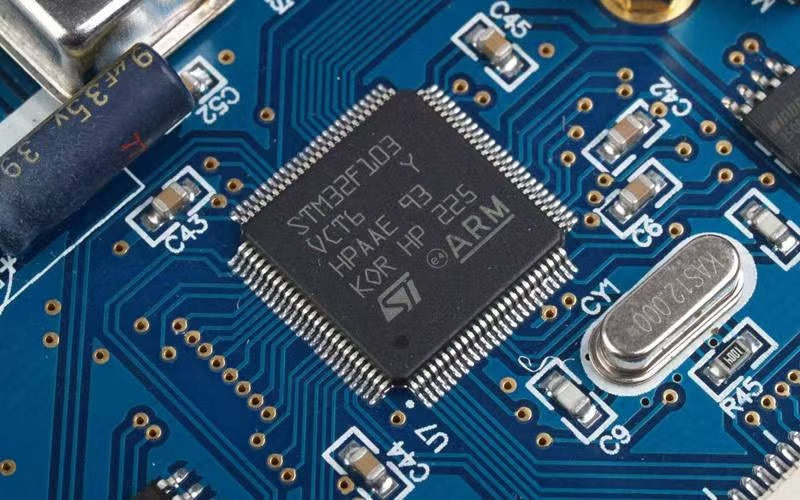
In the vast chain of electronics manufacturing, electronic component procurement might seem like a standard business process, but hidden risks lurk beneath the surface. A tiny chip worth a few dollars can determine the fate of equipment valued at thousands, even impacting a brand’s reputation. Counterfeit and remarked components are like ghosts in the industry, causing not only significant financial losses but also potentially catastrophic product failures. This guide serves as a detailed handbook to help you navigate these market traps, offering practical techniques for identification—from external inspection to internal analysis, and from supply chain management to quality control.
The Ripple Effect of a Single Bad Chip
Imagine a medical CT machine misdiagnosing due to a faulty image processing chip, a high-speed car losing control because its MCU fails, or a core network device crashing and causing a city-wide blackout after a power management IC burns out. These aren’t scare tactics; the root cause could trace back to a substandard or counterfeit component.
Procurement engineers and decision-makers must clearly understand that component sourcing is fundamentally a balance between quality, reliability, and cost. Choosing low-cost, non-authorised channels is like planting a time bomb within your company. This guide aims to give you the tools to defuse these bombs.

1. Knowing Your Enemy – Identifying Different Types of Components
Before engaging the “enemy,” you must first recognize them. Components in the market generally fall into these categories:
1.1 Authentic / Original Parts
- Definition:Brand new products manufactured, packaged, and tested by the original component manufacturer (OCM), sold through their authorised distributors or directly to end-users.
- Source:OCMs and their authorised distributors.
- Characteristics:Quality, performance, and reliability fully meet datasheet specifications. Come with complete traceability information and OCM warranty. The only recommended source for design and production.

1.2 New Surplus / Unauthorised Distribution
- Definition:These are often genuine OCM parts but distributed outside authorised channels. Sources can include excess inventory from OEMs/EMS, overstock, or parts simply removed from old boards and minimally processed. Their origin is complex, and quality status is a “black box.”
- Source:Independent distributors, brokers, traders.
- Characteristics:May look new but could have suffered from improper storage (moisture, ESD damage) or be near/exceeding their shelf life. Reliability is questionable, posing higher risk.
1.3 Refurbished / Remarked Parts
- Definition:Components salvaged from used circuit boards, then subjected to cleaning, sanding, re-marking, and re-plating of leads to make them appear new.
- Source:Typically from small, unregulated workshops.
- Characteristics:This is fraudulent. Parts have endured physical and thermal stress, leading to severely degraded performance, lifespan, and reliability. A primary cause of early-life failures.
1.4 Counterfeit / Fake Parts
- Definition:Outright fakes. Includes:
- Remarked Inferior Parts:Lower-grade/spec parts re-marked as higher-grade/spec (e.g., commercial grade marked as industrial, slower speed marked as faster).
- Old Sold as New:Essentially refurbished parts.
- Cloned/Copied Parts:Imitations produced by smaller factories, bearing fake logos and part numbers.
- Reclaimed Scrap:Parts salvaged from e-waste, minimally cleaned, often with oxidized leads and potentially damaged internal die.
- Characteristics:Most hazardous. Functionality is completely unreliable; these are pure scams.
To provide more intuitive decision-making support, we can evaluate these four source types across the dimensions of risk level and potential application:
| Source Type | Quality Risk | Supply Risk | Legal/Compliance Risk | Potential (and Limited) Application Scenarios |
| Authentic / Original | Very Low | Low (depends on channel stock) | Very Low | All scenarios, especially: Automotive, Medical, Aerospace, Industrial Control, Telecom Infrastructure, and other high-reliability fields. |
| New Surplus | Medium – High | Medium (unstable source) | Medium (no OEM warranty) | Repairs or stocking for non-critical, non-life-dependent consumer electronics, or prototype validation in R&D phases (requires strict testing before board assembly). |
| Refurbished | Very High | Low (but be cautious) | High (considered fraudulent) | Not recommended for any scenario in principle. Only in extreme exceptions, such as repairing obsolete old equipment with no available alternatives, as a last resort. Must clearly communicate the risks to the end user. |
| Counterfeit / Fake | Catastrophic | Low (but be cautious) | Very High | Prohibited for use in any scenario. |
Key Takeaway: This matrix illustrates that all choices other than authentic/original parts involve trading risk for cost or delivery time. Always assess the potential consequences of product failure before making a decision.
2. Keen Eyes – Practical Visual Inspection
Visual inspection is the first, fastest, and most direct line of defence. Use tools like magnifiers, microscopes, or digital microscopes.
2.1 Check the Marking (Ink)
- Clarity & Consistency:Original markings are sharp, crisp, even, and use a unique, consistent font. Fakes are often blurry, uneven, have fuzzy edges, or use incorrect fonts.
- Content & Placement:Verify all markings (Logo, P/N, Lot/Date Code) exactly match the OCM’s datasheet. Check the marking’s location and orientation.
- Durability:Gently rub the marking with an alcohol swab (use acetone cautiously, as some plastics degrade). Original markings resist removal; remarked ones often smear or wipe off easily.
- Fake Date Codes:Check if the date code format and logic align with the OCM’s standard. Some fakes even have “future” date codes.

2.2 Examine Body & Material
- Surface Texture:New original parts have a smooth, uniform surface finish. Refurbished parts, often sanded, may appear overly matte, show fine scratches, or have inconsistent texture. A thin coating is sometimes applied to hide sanding marks, feeling slightly tacky.
- Edges & Corners:Original parts have sharp, well-defined edges. Refurbished parts, tumbled or sanded, often have rounded edges – the “rounding” effect.
- Molding Compound:Feel the body material. Originals feel solid and robust. Fakes might use different plastics, feeling softer or more brittle.

2.3 Inspect the Leads/Pins
- Oxidation & Corrosion:New original leads are bright and shiny (or uniformly matte tin for lead-free), free from oxidation or corrosion. Surplus or reclaimed parts often have darkened, dull, or oxidized leads.
- Coplanarity & Scratches:Check if all leads lie flat on the same plane. Originals are flat. Refurbished parts may have bent leads from repeated handling. Under a microscope, originals show fine horizontal flow lines (from molding), while used/refurbished parts show vertical scratches from insertion/removal or test sockets.
- Plating Quality:Check plating for uniformity and flaking. Re-plated refurbished parts may have overly thick, uneven plating, or “tin whiskers.”


3. Scientific Verification – Physical & Electrical Testing

When visual inspection is inconclusive, professional testing methods are needed.
3.1 X-Ray Inspection (Non-Destructive)
- Principle:Looks inside the component without damaging it.
- What it Reveals:
Die Size: Verifies the internal silicon chip size matches a known good part. Fakes often use smaller/older dies.
Wire Bonds: Checks the gold/aluminum bonding wires for uniformity, alignment, and integrity. Refurbished parts may have sagging, broken, or misaligned wires due to reflow heat or de-soldering.
Voids & Delamination: Detects large air pockets (voids) or separation between the die, substrate, or molding compound – major reliability risks.
- Limitation:Requires expensive equipment, typically found in third-party labs or large companies.
3.2 Decapsulation (Destructive)
- Principle:Chemically or mechanically removes the package to expose the internal die.
- What it Reveals:
Die Markings: Reads the original OCM’s logo and code directly from the die itself, providing irrefutable proof against remarking.
Process & Vintage: Analyzes the die’s layout and feature size to estimate its age and technology node.
- Limitation:Destructive, costly, and time-consuming.
3.3 Electrical Testing
- Principle:Measures key parameters in a lab using multimeters, oscilloscopes, curve tracers, etc.
- What it Reveals:
Static Parameters: Measures values like diode Vf, transistor Vce(sat), MOSFET Rds(on), Vgs(th) against the datasheet.
Curve Tracing: Plots the device’s I-V characteristics and compares it to a known good sample. Even slight deviations can reveal fakes.
Functional Test: For digital ICs, sets up a simple circuit or uses a test socket to verify basic logic functions.
- Limitation:Requires expertise and equipment. Cannot guarantee 100% reliability under all conditions; only tests sampled parameters.
4. Prevention – Supply Chain Management & Source Verification
The best defence is avoiding dubious sources altogether. Building a robust supply chain is the ultimate solution.
4.1 Prioritise Authorised Channels
- Golden Rule:Whenever possible, always buy directly from OCMs or their authorised distributors.
- How to Find:Most major OCMs have a “Find a Distributor” tool on their website.
4.2 Vet Independent Distributors
When buying from independents (brokers) is unavoidable, rigorous supplier qualification is essential.
- Check Credentials:Business license, years in operation, industry certifications (e.g., ISO 9001, AS9120).
- Traceability:Demand full traceability documentation for the parts, like original OCM invoices, OEM excess certificates, or previous supplier details. Reliable suppliers provide clear proof of origin.
- Testing Capability:Ask if they have in-house testing (X-Ray, electrical) and are willing to provide reports.
4.3 Use OCM Anti-Counterfeiting Tools
Many large OCMs offer online verification tools using unique serial numbers or lot codes.
Pay attention to OCM counterfeit alerts.
4.4 Recognise Red Flags
- Price Too Low:Components priced significantly below market rate are 99% likely to be traps.
- High-Demand Parts Readily Available:Be highly suspicious if a supplier has unlimited stock of parts that are generally scarce industry-wide.
- Vague Answers:Suppliers who cannot or will not provide clear source documentation and test reports.
- Poor Packaging:Reel packaging is tampered with; tape & reels are not original; labels are blurry or incomplete.
5. Building Your Defence – Corporate Quality Management System
Individual experience isn’t scalable; systematic processes are sustainable. Companies should establish a complete component quality management system.
- Define a Clear Sourcing Policy:Formally mandate channel priority: Authorised distributors first, then qualified independents. Ban sourcing from unknown/unvetted suppliers.
- Establish an Incoming Inspection Function:Equip with necessary tools (microscopes, X-Ray) and create standard procedures for rigorous inspection of all materials from non-authorised sources.
- Maintain Approved/Vetted Supplier Lists (AVL):Dynamically manage suppliers. Build long-term relationships with reputable ones and blacklist those with poor records.
- Training & Knowledge Sharing:Regularly train procurement and QC staff on the latest counterfeit information, case studies, and techniques.
- Reserve Legal Rights:Pursue legal action against suppliers who provide counterfeit components to protect your interests.
6. Q&A
Rely on processes, not just people: 1) Implement a sourcing policy favouring authorised channels. 2) Create an approved supplier list and audit them. 3) Set up an incoming inspection department with standards. 4) Train procurement and QC staff regularly.
7. Summary
In the battlefield of component procurement, trust is essential, but verification is mandatory. From training your eye for visual clues, to leveraging technology for deeper inspection, and finally building the “fortress” of a robust supply chain – this is a systematic defence strategy. Every successful identification, every refusal of a too-good-to-be-true price, not only prevents financial loss but also reinforces your commitment to product quality and end-user safety. Remember, in the world of electronic components, “cheap” often comes at the highest cost.
Orinew is a professional one-stop PCB service provider with 14 years of expertise in component distribution. We guarantee that every component we supply is 100% authentic, brand new, and traceable to its original source. Trust Orinew for quality and reliability you can count on.
Related Posts
ORINEWPCB · PROJECT SUPPORT
Contact Us
Discuss your PCB assembly project with our team.
FREE QUOTE
Plan your turnkey PCBA build.
Share your quantity and requirements. Add Gerber files and a BOM when ready.
Files are optional for an initial discussion. Include any assembly, sourcing or testing requirements in your message.