
Barrel Connectors
Barrel Connectors are common power connection components in electronic devices, mainly used for stable power transmission between DC power supply and devices.
1. Barrel Connectors Overview
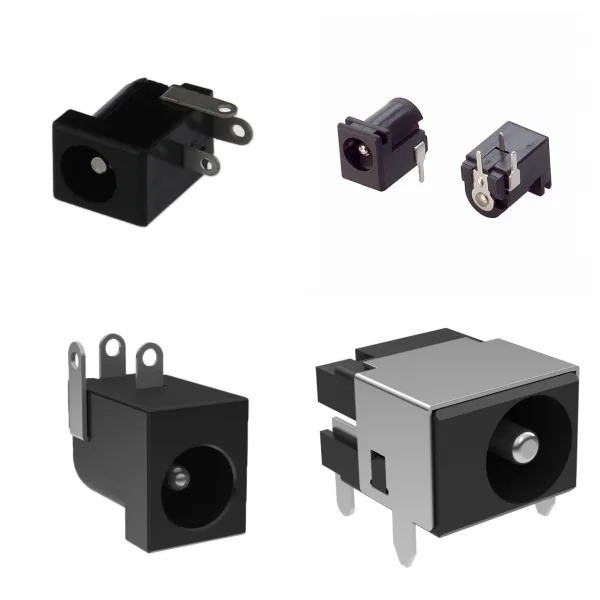
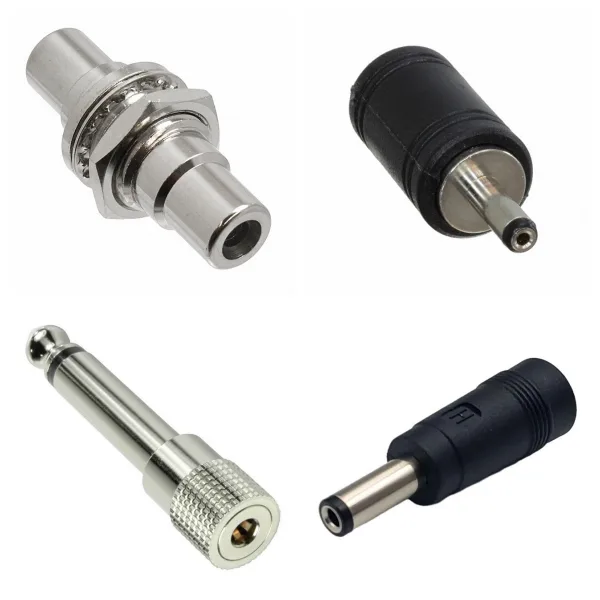
Barrel Connectors consist of a pair of cylindrical metal connectors, including a plug (male) and a socket (female). The center of the plug is a protruding pin, and the socket is a center hole, which realizes circuit conduction through physical plugging. In the Chinese classification, it belongs to a type of rectangular connector, but in actual applications, it is more reflected in the cylindrical structure design.
2. What is the Core Structure of Barrel Connectors?
Physical Connection Design
The plug and the socket are matched through the center pin and hole to ensure the stability of power transmission; the external materials are mostly metal or plastic, taking into account both structural strength and electrical insulation.
Polarity Identification
Polarity is usually marked by positive and negative symbols, arrows, or color coding to prevent device damage or power failure caused by reverse plugging.
Specification Diversity
Supports a variety of diameters, lengths, and power specifications to adapt to the power requirements of different devices.
3. What are Barrel Connectors Used for?
Electronic Equipment Power Supply: such as routers, surveillance cameras, etc., connected to a DC power supply through an adapter.
Household Appliances: Some small household appliances use this type of interface to simplify power supply design.
Industrial Equipment: Suitable for communication and control modules that require stable DC input.
4. Industry Positioning and Technology Extension of Barrel Connectors
Commonality of Connector Functions
As a “bridge” between circuits, Barrel Connectors meet the core function of connectors: establishing a separable conduction path between isolated circuits to improve equipment assembly and maintenance efficiency.
Technology Development Trend
Although the evolution direction of Barrel Connectors is not directly mentioned, the connector industry as a whole tends to be miniaturized, high-density, and high-reliability design, and such characteristics may gradually penetrate into the field of power connectors.
5. Comparison with Other Connectors
With board-to-board Connectors: The latter focuses on signal transmission between circuit boards, while Barrel Connectors focus on power transmission.
With high-frequency/RF Connectors: High-frequency types (such as SMA and BNC) focus on signal integrity, while Barrel Connectors emphasize current carrying capacity.
Barrel Connectors FAQs
1) How to ensure the correct polarity connection of Barrel Connectors?
Correct polarity can avoid device damage or power failure. Barrel Connectors usually identify polarity in the following ways:
Physical Markings: positive and negative symbols, polarity arrows, or color coding.
Internal Structure: Some models prevent incorrect plugging through the tip, sleeve, or middle ring design.
2) What are the common specifications and sizes of Barrel Connectors?
Diameter: Common specifications include 2.1mm, 2.5mm, 3.5mm, etc., to adapt to the power requirements of different devices.
Contact Type: It is divided into mono (TS, 2-core) and stereo (TRS, 3-core) structures, the latter supports more complex switching functions.
3) Are there any alternative technologies for Barrel Connectors?
USB-C has gradually become an alternative to Barrel Connectors due to its high power transmission (supporting USB PD 3.0 standard) and data compatibility. For example:
EZ-PD™ BCR Series: supports 5V to 3A power supply, integrated MCU controller, and customizable power supply protocol.
Versatility: The USB-C interface is more popular in the field of consumer electronics and has higher compatibility.
4) How does the internal structure of the Barrel Connector affect the function?
TS Plug: Contains only the tip and sleeve, used for mono power transmission, and some contain normally closed/normally open switches.
TRS Plug: Adds an intermediate ring (Ring) to support stereo signals or multi-way switch control.
Different structures can meet the specific needs of the device for power management or signal transmission.
