
ORINEWPCB · ORIGINAL COMPONENTS & TURNKEY PCBA

Audio Products — Component Sourcing

Source Audio Products for your design or PCB assembly build. Send exact manufacturer part numbers and quantities to check our inventory and manufacturer or distribution-partner sourcing options.

100% new, original, genuine components. We supply only new, original, genuine materials to customers. The same commitment applies to components we supply for turnkey PCB assembly.

We seek competitive pricing and delivery options through our sourcing relationships. Confirm the exact part, available quantity, packaging and delivery date in your quotation. Catalog counts and listed quantities are not a live stock reservation.

Cannot find a part? Send the full part number or your BOM; the directory is not the limit of our sourcing service.

One part number or a complete BOM?

For individual parts, send the exact manufacturer part number, manufacturer, quantity and required date. For a BOM, include part numbers, quantities per board, reference designators and any approved alternatives.

Send your sourcing requirements

Need the components assembled?

Keep the board files and BOM on one revision. Request PCB fabrication, sourcing and assembly together, with programming or functional testing defined for your build.

Explore full turnkey PCB assembly

Browse Categories or Part Numbers.

Cannot find your part in the directory? Send the full part number or your BOM for review.
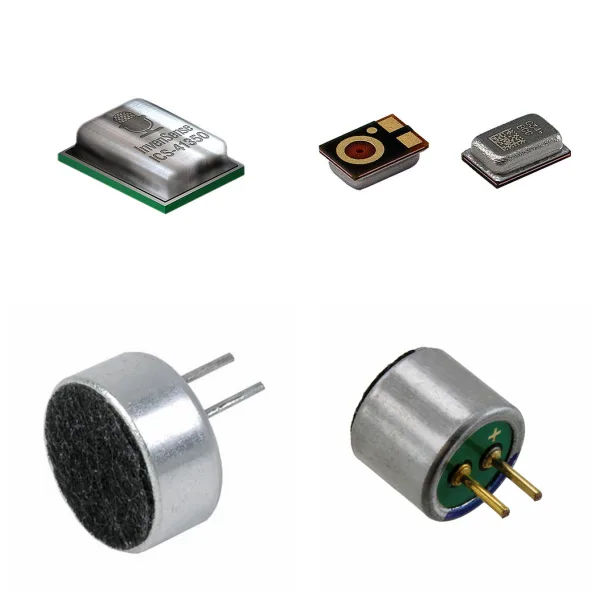
Representative electronic component category image
<h1> Microphones </h1> <h2> 1. Microphones Overview ‌ </h2> <p> Microphone is a transducer device that converts sound wave signals into electrical signals. It is widely used in communication equipment, consumer electronics, medical instruments, and other fields. Its core function is based on the conversion of mechanical vibration caused by sound pressure changes and electrical parameters (such as capacitance and voltage). </p> <p>   </p> <h2> ‌2. What is the Classification and Working Principle of Microphones?‌ </h2> <h3> 1) ‌Dynamic Microphone ‌ </h3> <p>   </p> <p> <strong>Principle</strong>: Using electromagnetic induction, sound waves drive the diaphragm to drive the coil to move in the magnetic field, generating induced current. </p> <p> <strong>Features</strong>: Simple structure and durability, but low sensitivity, poor high-frequency response, suitable for human voice recording. </p> <p>   </p> <h3> 2) ‌Capacitive Microphone ‌ </h3> <p>   </p> <p> <strong>Principle</strong>: Sound pressure causes the capacitance between the diaphragm and the backplate to change, and the bias voltage is provided by the charge pump. The signal is output after ASIC amplification. </p> <p> <strong>Subtypes</strong>: </p> <p> <strong>√‌MEMS Microphone‌</strong>: The silicon-based diaphragm is etched using micro-electromechanical technology, and the ASIC chip is integrated. It has the characteristics of small size and good consistency. ‌ </p> <p> <strong>√‌Electret Microphone ‌</strong>: The built-in electret material provides a fixed charge, and no external bias power supply is required. It is often used in consumer electronics products. ‌ </p> <p>   </p> <h3> 3) ‌Piezoelectric Microphone‌ </h3> <p>   </p> <p> <strong>Principle</strong>: Utilize the mechanical stress-voltage effect of piezoelectric materials to directly convert vibration into electrical signals, and it has been gradually applied to the MEMS field in recent years. ‌ </p> <p>   </p> <h2> ‌3. What are the Structural Features of Microphones?‌ </h2> <p> <strong>‌MEMS Microphone‌</strong>: </p> <p> It is composed of a silicon diaphragm and a perforated backplate to form a variable capacitor. The front cavity/back cavity design affects the frequency response characteristics (such as the large front cavity of the Top type and the low high-frequency resonance point). ‌ </p> <p>   </p> <p> Packaging forms include COB (Chip On Board) and surface mounting, supporting digital/analog output. ‌ </p> <p> <strong>‌Electret Microphone‌</strong>: </p> <p> It includes an electret backplate and a field effect transistor to simplify the circuit design, but it needs to be matched with an impedance-matching circuit. ‌ </p> <p>   </p> <h2> ‌4. What are the Key Parameters of Microphones?‌ </h2> <p> <strong>‌Sensitivity‌</strong>: Expressed in dBV (analog) or dBFS (digital), reflecting the efficiency of converting sound pressure into electrical signals. ‌ </p> <p> <strong>‌Frequency Response‌</strong>: Determines the microphone's ability to capture sound waves of different frequencies, such as the Top type MEMS has a narrow frequency response range. </p> <p> ‌ </p> <p> <strong>‌Signal-to-noise Ratio (SNR)</strong>: Related to thermal noise, MEMS microphones reduce noise by optimizing diaphragm materials (such as silicon nitride). </p> <p> <strong>‌Maximum Sound Pressure Level (SPL)</strong>: The upper limit of sound pressure that a microphone can withstand. Digital MEMS usually supports 120 dB SPL. </p> <p>   </p> <h2> 5. What are Microphones Used for? </h2> <p> <strong>‌Consumer Electronics</strong> ‌: Mobile phones, headphones (MEMS-based). </p> <p> <strong>‌Industrial and Medical</strong> ‌: Voice-controlled equipment, hearing aids (requires high sensitivity and low noise). </p> <p> <strong>‌Professional Audio</strong> ‌: Recording equipment, stage microphones (dynamic/capacitive-based). </p> <p>   </p> <h2> 6‌. What are the Development Trends of Microphones?‌ </h2> <p> <strong>‌Integration</strong> ‌: High integration of MEMS and ASIC chips to improve signal processing efficiency. </p> <p> <strong>‌Miniaturization</strong> ‌: Silicon-based processes drive microphone size down to the millimeter level to meet the needs of wearable devices. </p> <p> <strong>‌Multimodal Fusion ‌</strong>: Combining piezoelectric and capacitive technologies to optimize frequency response and signal-to-noise ratio. </p> <p>   </p> <h2> 7. Typical Brands for Microphones </h2> <p> Analog </p> <p> Goertek </p> <p> Infineon </p> <p> SparkFun </p> <p> TDK </p> <p> And so on... </p> <p>   </p> <h2> 8. Microphones FAQs </h2> <h3> ‌1) How to choose a suitable microphone? ‌ </h3> <p> <strong>‌Type is Determined by Purpose‌</strong>: Condenser microphones are preferred in recording studios; dynamic microphones can be considered for live broadcasts or outdoor scenes; MEMS microphones are recommended for mobile devices‌. </p> <p> <strong>‌Interface Compatibility‌</strong>: Pay attention to the device interface type (such as 3.5mm, USB, or Lightning). Some iPhones require external microphones to be connected via adapters‌. </p> <p> <strong>‌Performance Parameters‌</strong>: Pay attention to signal-to-noise ratio (SNR), sensitivity, and frequency response range. For example, MEMS microphones have the advantages of ultra-low noise and phase matching‌. </p> <p>   </p> <h3> ‌2) How to solve the microphone connection problem? ‌ </h3> <p> <strong>‌External Microphone for iOS Devices‌</strong>: If the device does not have a 3.5mm interface (such as iPhone 7 and above), you need to use a Lightning to 3.5mm adapter or a USB microphone that supports digital signals‌. </p> <p> <strong>‌Wireless Microphone Interference‌</strong>: Check whether the wireless frequency band conflicts and ensure that the distance between the transmitter and the receiver is within the effective range. </p> <p>   </p> <h3> ‌3) How do the technical parameters of the microphone affect the use effect? ‌ </h3> <p> <strong>‌Signal-to-noise Ratio (SNR)</strong>: The higher the value, the lower the background noise (e.g. MEMS microphones can reach 74dB SNR). ‌ </p> <p> <strong>‌Sensitivity</strong>: Determines the ability to pick up sound. Condenser microphones are usually more sensitive than dynamic microphones. ‌ </p> <p> <strong>‌Total Harmonic Distortion (THD)</strong>: Low distortion (e.g. <1%) can ensure sound reproduction, especially in high-voltage sound fields (e.g. instrument recording). ‌ </p> <p>   </p> <h3> ‌4) What are the differences between microphones in different application scenarios? ‌ </h3> <p> <strong>‌Live Broadcast/Game</strong>: Low latency and high clarity are required. It is recommended to choose a USB condenser microphone or a professional gaming headset microphone. ‌ </p> <p> <strong>‌Conference/Lecture</strong>: Lavalier microphones or array microphones (such as the built-in solution of Huawei IdeaHub devices) can improve voice clarity. ‌ </p> <p> <strong>‌Music Recording</strong>: Condenser microphones are suitable for vocals and strings, while dynamic microphones are more suitable for percussion or electric guitar. </p> <p> ‌ </p> <h3> ‌5) What are the Common problems and solutions for using microphones?‌ </h3> <p> <strong>‌Too much Background Noise‌</strong>: Check the stability of the power supply (condenser microphones require stable phantom power), or replace the microphone with a higher SNR‌. </p> <p> <strong>‌Insufficient Sensitivity‌</strong>: Adjust the device gain setting, or choose a microphone type with higher sensitivity (such as a condenser). </p> <p> <strong>‌Compatibility Issues‌</strong>: Confirm that the operating system or software driver supports it. Some professional microphones require the installation of specific drivers‌. </p>

*Listed quantities are subject to confirmation. Catalog photos are representative; confirm the exact package and datasheet with your inquiry.

Prepare Audio Products for a Useful Quotation

Start with the approved manufacturer part number and the actual build requirement. A category name or a similar-looking package is not enough to confirm an interchangeable part.

Quotation inputWhat to provide
Part identityManufacturer and complete orderable part number, including suffixes. List approved alternatives separately.
Category-specific checksDevice function and electrical interface; dimensions and mounting; sensitivity, impedance, power or acoustic requirements as applicable.
Quantity and timingRequired quantity, requested date and destination. For a BOM, include quantity per board and assembly build quantity.
Packing and documentationReel, cut tape, tray or other required format; specify date/lot conditions and supporting-document needs before ordering.
Complete board buildFor turnkey PCBA, include the BOM revision, matching PCB files, placement data, assembly drawing and test requirements.

On small screens, swipe the table horizontally. Review technical requirements against the current manufacturer datasheet before approval.

Request pricing and delivery options · Explore our BOM sourcing service · Combine sourcing with turnkey PCB assembly

Component Sourcing & Turnkey PCBA FAQ

Are the components new and original?

Yes. OrinewPCB supplies only 100% new, original, genuine electronic components. We do not supply used, refurbished or remarked material. This commitment also covers the components we supply for customers’ turnkey PCB assembly builds.

Can you source a part that is not in your own stock?

Yes. We work with component manufacturers and distribution partners to review sourcing options beyond our substantial inventory. Send the exact part number and quantity so pricing, availability and delivery can be confirmed for your request.

Does a listed quantity confirm immediate delivery?

Confirm the current available quantity, packaging, any date/lot requirements and delivery date in your quotation. Directory counts and listed quantities do not reserve material or confirm that every listed item is currently in our own warehouse.

Can I request a full BOM and finished PCB assemblies?

Yes. Send the BOM together with matching PCB design files and build quantity. State whether you need components only, partial turnkey or full turnkey PCB assembly, and identify programming and testing requirements.

Will you change a part number without our approval?

No. Proposed substitutes must be reviewed and approved by your team before they replace the released BOM. Tell us which lines cannot be substituted and which approved alternatives may be quoted.

PARTS, BOM OR COMPLETE PCBA

Request your component or BOM quote.

Tell us whether you need parts only or a finished PCB assembly. Availability, price, order quantity and delivery are confirmed for your specific request.

  • Exact manufacturer part numbers and manufacturers
  • Required quantity, target date and shipping destination
  • BOM file and quantity per board for a complete build
  • Approved alternatives and any parts that must not be substituted
  • For turnkey PCBA: PCB files, placement data and test requirements

Proposed substitutions need your approval. Tell us about traceability, documentation or packaging requirements before purchasing is agreed.

Files are optional for an initial discussion. You can send the BOM by email if the uploader does not accept your file. An inquiry does not authorize purchasing or production.

[email protected]

Start with your requirements.

Email is required. Add “components only” or “full turnkey PCBA” in the service field.
