PIR Sensors: The Ultimate Guide to Motion Detection

Table of Content
In our increasingly automated world, sensors play a pivotal role in enabling smart systems to interact with their environment. Among these, Passive Infrared(PIR) sensors stand out as a foundational technology for motion detection. From enhancing security to optimizing energy consumption, PIR sensors are ubiquitous, yet their sophisticated simplicity is often overlooked. This comprehensive guide will delve into the intricacies of PIR sensors, explaining their fundamental principles, key components, diverse applications, and significant advantages.
1. What are PIR Sensors?
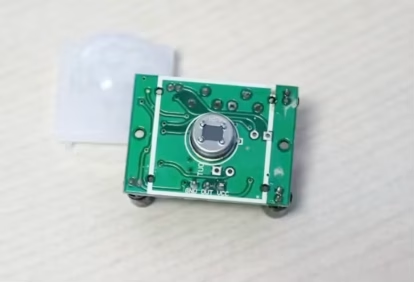
A PIR sensor, or Passive Infrared sensor, is an electronic device that measures infrared(IR) light radiating from objects in its field of view. Unlike active sensors that emit their own energy(like ultrasonic or radar sensors), PIR sensors are “passive” because they only detect the IR energy emitted by other objects. All objects with a temperature above absolute zero(0 Kelvin or -273.15 °C) emit thermal energy in the form of infrared radiation. Human bodies, animals, and even inanimate objects at room temperature constantly radiate IR energy.
PIR sensors are specifically designed to detect changes in these infrared levels. When a warm body, such as a person or an animal, moves into or out of the sensor’s range, it causes a fluctuation in the detected IR radiation. The sensor then interprets this change as motion, triggering an output signal. This makes them ideal for applications requiring the detection of living beings, distinguishing them from stationary backgrounds.
2. How do PIR Sensors Work?
The operation of a PIR sensor is a clever combination of physics and electronics, designed to detect subtle changes in infrared energy. Here’s a breakdown of the process:
2.1 Infrared Radiation Detection
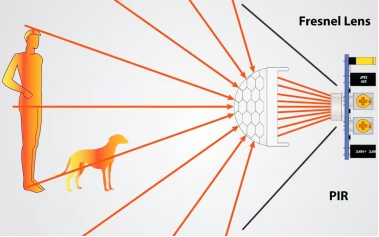
The core of a PIR sensor is a pyroelectric sensor, which is a transducer that generates an electrical charge when exposed to infrared radiation. These sensors are typically split into two or more facets, often two, which are wired in opposition. This differential arrangement is crucial for detecting motion, as it allows the sensor to ignore static changes in IR and focus only on dynamic ones.
2.2 The Role of the Fresnel Lens
Covering the pyroelectric sensor is often a specialized plastic lens, known as a Fresnel lens. This lens doesn’t just protect the sensor; it plays a critical optical role:
- Focusing IR Energy: It concentrates the infrared radiation from the environment onto the pyroelectric sensing elements.
- Segmenting the Field of View: The Fresnel lens is typically segmented into multiple facets, creating an array of “detection zones”. These zones alternate between positive and negative detection areas.
- Enhancing Range and Angle: It effectively widens the sensor’s field of view and extends its detection range beyond what a bare pyroelectric sensor could achieve.
When a warm body moves across these segmented zones, it successively enters and exits areas focused on different facets of the pyroelectric sensor. For example, moving from a “positive” zone to a “negative” zone will cause the differential voltage across the sensor elements to change significantly.
2.3 Signal Processing
The tiny electrical signal generated by the pyroelectric sensor due to these IR changes is very weak. It undergoes several stages of processing:
- Amplification: An internal amplifier boosts the weak signal to a usable level.
- Filtering: The signal is filtered to remove electrical noise and focus on the frequencies associated with human motion.
- Comparison: A comparator circuit then compares the amplified and filtered signal against a predefined threshold. If the change in IR intensity crosses this threshold, it signifies motion.
- Output: Finally, the sensor module typically outputs a digital signal (HIGH or LOW) to indicate the presence or absence of motion. A HIGH signal usually means motion detected, while a LOW signal means no motion or the motion has ceased.
This “change detection” mechanism is fundamental to PIR operation. The sensor detects changes in IR patterns, not the absolute IR level. This is why a person standing perfectly still within the detection zone might not continually trigger the sensor after the initial movement. The PIR sensor needs continued movement to register a trigger.
3. Key Components of a PIR Sensor
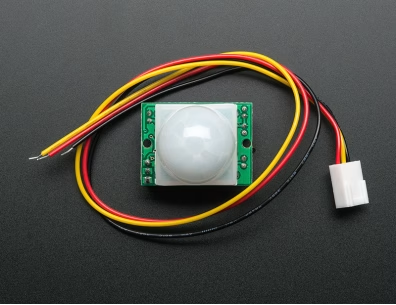
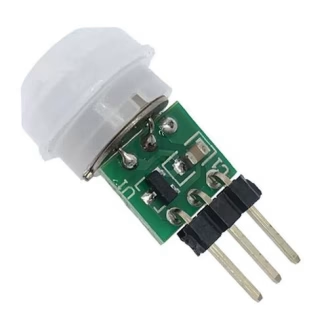
While often seen as a single unit, a PIR sensor module comprises several distinct components working in harmony:
1) Pyroelectric Sensor: The core component responsible for converting incident infrared radiation into an electrical signal. It typically has two sensing elements to detect differential changes.
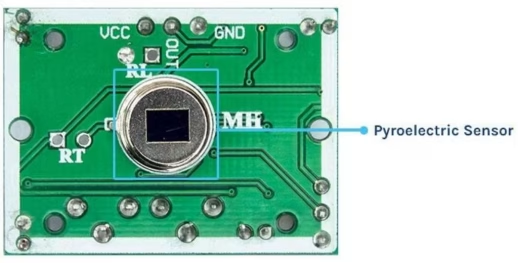
2) Fresnel Lens: A multi-faceted plastic lens that focuses IR radiation onto the pyroelectric sensor and segments the detection area into sensitive zones.
3) Control Circuitry: This integrated circuit(IC) includes:
- Amplifier: Boosts the minute electrical signal from the pyroelectric sensor.
- Comparator: Compares the amplified signal against a reference voltage to determine if motion has occurred.
- Voltage Regulator: Ensures a stable power supply to the sensor components.
- Timers/Delay Circuits: Many PIR modules include adjustable timers for output pulse duration and re-triggering delays.
4) Pin Configuration: Typically includes:
- VCC(Power Supply):Connects to the positive voltage source(e.g., 5V).
- GND(Ground):Connects to the negative terminal of the power supply.
- OUT(Output):Provides the digital signal(HIGH/LOW) indicating motion detection.
5) Potentiometers(Adjustable Settings): Many modules feature potentiometers for adjusting sensitivity(detection range) and delay time(how long the output stays HIGH after detection).
4. Advantages of PIR Sensors
PIR sensors offer a compelling set of advantages that contribute to their widespread adoption across various industries:
- Energy Efficiency: PIR sensors consume very little power, making them ideal for battery-operated devices and continuous monitoring applications where power conservation is critical.
- Cost-Effectiveness: Compared to many other types of motion or presence sensors, PIR sensors are relatively inexpensive to manufacture and integrate, contributing to their pervasive use in consumer electronics and smart home devices.
- Reliability and Durability: As a mature technology, PIR sensors are known for their robust and reliable performance. With no moving parts, they are generally durable and require minimal maintenance.
- Non-Intrusive Operation: Being “passive”, these sensors do not emit any radiation, making them safe for use around humans and animals. This also means they do not interfere with other electronic devices.
- Ease of Integration: PIR sensor modules are typically simple to interface with microcontrollers like Arduino or Raspberry Pi, requiring minimal external components and basic coding skills.
- Versatility: Their ability to detect heat signatures from living beings makes them suitable for a wide array of applications, from security to automated lighting and energy management.
- Broad Detection Angle: With the help of Fresnel lenses, PIR sensors can cover a relatively wide field of view, making them effective for monitoring large areas.
5. Applications of PIR Sensors
The versatility and efficiency of PIR sensors have led to their integration into countless applications across different sectors:
- Security Systems: This is perhaps the most well-known application. PIR sensors are critical components in home and commercial alarm systems, detecting intruders by sensing their movement and triggering alerts.
- Automated Lighting :In homes, offices, and public spaces, PIR sensors are used to automatically turn lights on when a person enters a room and off when they leave. This saves energy and adds convenience, especially in hallways, restrooms, and outdoor security lights.
- Smart Home Automation: PIR sensors enable various smart home functions, such as adjusting thermostat settings based on occupancy, controlling smart plugs, or activating smart speakers when someone enters a room.
- Energy Management: By detecting presence, PIR sensors can optimize energy consumption in HVAC systems, turning heating or cooling off in unoccupied zones, leading to significant energy savings.
- Automatic Doors and Gates: They can detect approaching individuals or vehicles, automatically opening doors or gates, enhancing accessibility and convenience in commercial buildings and private properties.
- Occupancy Sensing: Beyond simple motion, PIR sensors can infer occupancy to manage office spaces, monitor elder care, or even provide data for building management systems.
- Proximity Detection: In some industrial settings, they can be used for simple proximity detection of large, warm objects.
- Wildlife Monitoring: In environmental research, PIR sensors are often used in camera traps to capture images or videos of animals when they pass by, minimizing disturbance to wildlife.
6. Limitations and Considerations
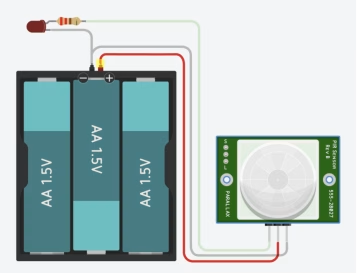
While highly effective, PIR sensors do have certain limitations that need to be considered for optimal performance:
- Line of Sight Requirement: PIR sensors require an unobstructed view of the area they are monitoring. They cannot detect motion through walls, glass, or dense foliage.
- Temperature Sensitivity: Their performance can be affected by ambient temperature. If the background temperature is very close to the temperature of the moving object, the contrast in IR radiation might be insufficient for detection, leading to reduced sensitivity. Rapid temperature changes in the environment(e.g., from heating vents) can also cause false triggers.
- False Triggers: PIR sensors can be susceptible to false alarms caused by non-human sources of heat or movement, such as pets , rapid air currents(from AC vents or open windows), direct sunlight, or even flickering lights mimicking IR changes.
- No Movement = No Detection: As they detect changes in IR, a person standing perfectly still within the detection zone will eventually cease to trigger the sensor. Continuous presence detection typically requires additional sensor types.
- Lack of Specificity: PIR sensors detect any change in a heat signature. They cannot distinguish between a human, an animal, or a warm object moving across its field of view without additional intelligence.
- Limited Range and Angle: While Fresnel lenses help, PIR sensors still have a defined detection range and angle. Detection sensitivity decreases with distance.
7. PIR Sensor FAQs
PIR stands for Passive Infrared, a sensor technology that detects motion by measuring changes in infrared radiation (heat) emitted by nearby objects, such as people or animals. It is commonly used in security cameras, motion-activated lights, and alarm systems to reduce false alerts.
No, PIR sensors require a direct line of sight. They cannot detect motion through opaque objects like walls or even through standard glass, which blocks most infrared radiation.
No, PIR sensors detect infrared radiation (heat), which is outside the visible light spectrum. Therefore, they are not directly affected by ambient visible light levels, though extreme heat from direct sunlight could potentially influence background temperature readings.
The detection range varies significantly depending on the specific sensor model and the design of its Fresnel lens. Common ranges for consumer-grade sensors are typically between 5 to 12 meters(15 to 40 feet). Industrial or specialized sensors can have longer ranges.
Many PIR modules include an adjustable delay time. This is to prevent rapid on/off cycling of connected devices(like lights) and to ensure that once motion is detected, the output signal remains active for a usable duration, even if the movement is brief. It also often includes a re-triggering delay to prevent immediate re-triggering for a short period after the initial detection.
8. Summary
PIR sensors are indispensable tools for detecting motion by passively sensing changes in infrared radiation emitted by objects. Their core components, including the pyroelectric sensor and Fresnel lens, work together to convert thermal energy fluctuations into electrical signals, indicating movement. With advantages such as low power consumption, cost-effectiveness, and ease of integration, PIR sensors have become fundamental to various applications, from robust security systems and energy-saving automated lighting to advanced smart home solutions.
Related Posts
ORINEWPCB · PROJECT SUPPORT
Contact Us
Discuss your PCB assembly project with our team.
FREE QUOTE
Plan your turnkey PCBA build.
Share your quantity and requirements. Add Gerber files and a BOM when ready.
Files are optional for an initial discussion. Include any assembly, sourcing or testing requirements in your message.