
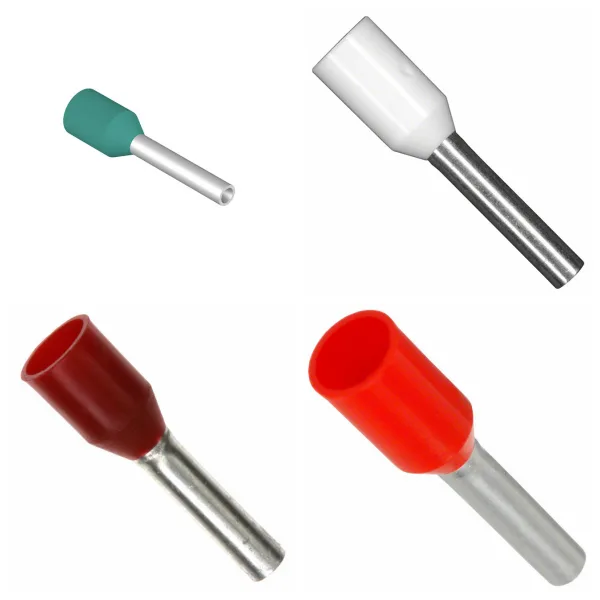
<h1> Terminal Block Wire Ferrules </h1> <p> Terminal Block Wire Ferrules play a key role in connection and protection in electronic components. </p> <p> </p> <h2> 1. What are the Core Functions of Terminal Block and Wire Ferrules? </h2> <p> <strong>Wire Ferrules</strong>: Insulated tubular terminals are specially used for the termination of multi-stranded wires. Through crimping, each metal wire of the wire can reliably conduct current to avoid wire breakage under bending, vibration, or stress. The double terminal design allows the connection of two independent wires, which is suitable for jumper scenarios. </p> <p> <strong>Terminal Block</strong>: As a connection fixture, it provides a screw-clamped or spring-clamped interface to achieve stable connection, power distribution, and signal management of wires/cables, with high reliability and easy maintenance. </p> <p> </p> <h2> 2. What are the Synergistic Advantages of Terminal Block and Wire Ferrules? </h2> <p> <strong>Improved Reliability</strong>: The cold-pressed terminal is pre-installed at the end of the stranded wire and then connected to the terminal block, which fundamentally solves the problem of loose wires and enhances the stability of long-term connections. </p> <p> <strong>Efficient Maintenance</strong>: The terminal block supports modular combination, and the cold-pressed terminal can simplify the wire removal and reorganization process during equipment maintenance. </p> <p> </p> <h2> 3. What are the Typical Types and Applications of Terminal Block Wire Ferrules? </h2> <p> <strong>Protective Terminal Blocks</strong>: For example, the TL series supports PCB welding, with a spacing of 3.5mm–7.62mm, suitable for 0.05–8.37mm² wires, and meets diverse connection needs. </p> <p> <strong>Fuse Terminal Blocks</strong>: Some terminal blocks integrate fuse functions (such as the TLF series) to provide circuit overload protection. </p> <p> <strong>Industrial Scenarios</strong>: Widely used in instruments, electrical control cabinets, and automation equipment, especially in vibration environments or scenarios where repeated wiring is required. </p> <p> </p> <p> This component significantly improves the safety and life of the connection system through the combination of mechanical reinforcement and electrical optimization. </p> <p>
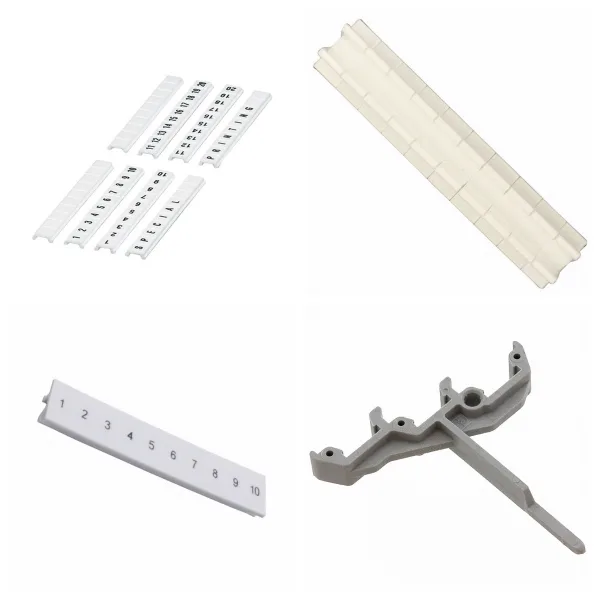
<h1> Terminal Block Marker Strips </h1> <p> Terminal block marker strips are specialized labeling components designed for electronic terminal blocks that clearly identify terminal points in circuits and components. </p> <p> </p> <p> <strong>Key Benefits of Terminal Block Marker Strips</strong>: </p> <h3> 1) Optimized Workflow </h3> <p> These marker strips feature a multi-section design that easily snaps into the terminal block slots, allowing users to remove and install them as needed for modular setups. </p> <p> </p> <p> Each sheet typically contains multiple individual labels (e.g., 60), facilitating batch labeling and reducing installation time. </p> <p> </p> <p> These markers are typically available in uniform sheets or strips, optimizing the labeling workflow in industrial and commercial applications. </p> <p> </p> <h3> 2) Good Reliability </h3> <p> Able to withstand temperatures ranging from -40°C to 120°C, they remain durable in harsh conditions. </p> <p> </p> <h3> 3) Compatible with a variety of Models </h3> <p> Standard sizes vary, such as 5.6mm in width and 10.5mm in length, and can be customized for terminal widths such as 6.2mm. </p> <p> </p> <h3> 4) Facilitates Global Trade </h3> <p> In international markets, these markers support seamless integration with printing systems such as THERMOMARK or BLUEMARK, allowing customized text or symbols to be printed via thermal transfer or inkjet for precise functional identification. This improves the accuracy of communication in global trade, minimizes wiring errors, and promotes efficient maintenance of electronic projects. </p> <p>
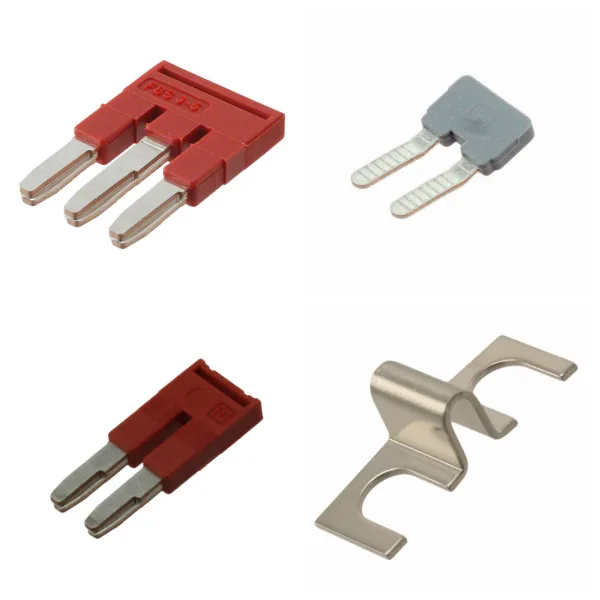
<h1> Terminal Block Jumpers </h1> <p> Terminal Block Jumpers are specialized connectors used for bridging electrical terminals, particularly facilitating shorting between blocks of different sizes to simplify circuit modifications. </p> <p> </p> <h2> 1. What are the Functions of Terminal Block Jumpers? </h2> <p> They enable easy jumpering of terminal blocks, such as connecting CP series blocks (e.g., CP6 to CP4), with features like breakout pins for skipping terminals and multiple channels for flexible circuit configurations. </p> <p> </p> <h2> 2. What are the Types of Terminal Block Jumpers? </h2> <p> Common variants include step-down jumpers (e.g., JXS6/2.5 for CP6 to CP2.5), available in pole configurations from 2-position to 16-position, and color-coded options like blue or red for quick identification. </p> <p> </p> <h2> 3. What are Terminal Block Jumpers Used for? </h2> <p> Essential in industrial and PCB setups for managing wire size variations, supporting push-in technology for secure installations, and minimizing rewiring efforts in control systems. </p> <p> </p> <p> These jumpers enhance wiring efficiency in electrical assemblies, ensuring reliable connections across diverse terminal standards. </p> <p>
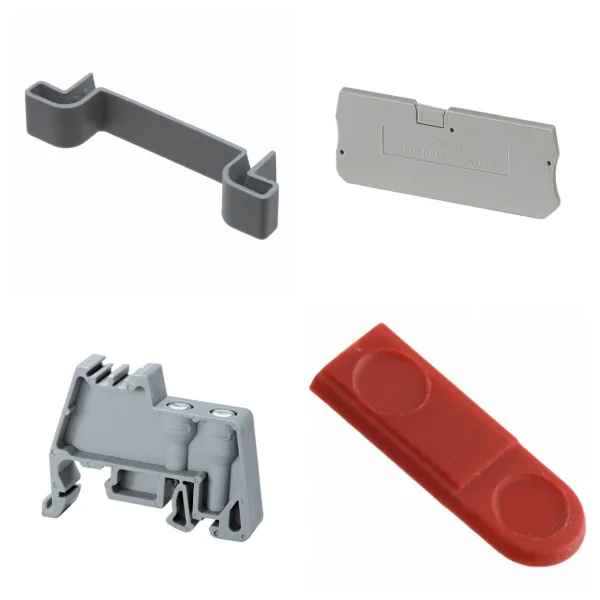
<h1> Accessories </h1> <p> Terminal block accessories include complementary items such as end caps, base strips, brackets, bus bars, coding keys, connection rings, dummy plugs, lighting indicators, terminals and retaining clips, and many other items used with terminal block connectors. </p> <p>
Terminal Block Accessories
Terminal Block Accessories are supplementary items such as end caps, base strip, brackets, busbar, coding key, connecting link, dummy plug, lighting indicator, terminals, and a retaining clip plus many others used with terminal block connectors.
