
ORINEWPCB · COMPONENTS & TURNKEY PCBA
D-Sub, D-Shaped Connectors — Component Sourcing
Browse D-Sub, D-Shaped Connectors and send the exact manufacturer part number, required quantity and target date. For a complete board build, include your BOM and PCB files in a turnkey PCBA request.
Catalog entries and category counts do not confirm stock or delivery. Availability, pricing and any proposed alternatives are reviewed for your request.
One part number or a complete BOM?
For individual parts, send the exact manufacturer part number, manufacturer, quantity and required date. For a BOM, include part numbers, quantities per board, reference designators and any approved alternatives.
Need the components assembled?
Keep the board files and BOM on one revision. Request PCB fabrication, sourcing and assembly together, with programming or functional testing defined for your build.
Browse component categories.
Cannot find your part in the directory? Send the full part number or your BOM for review.
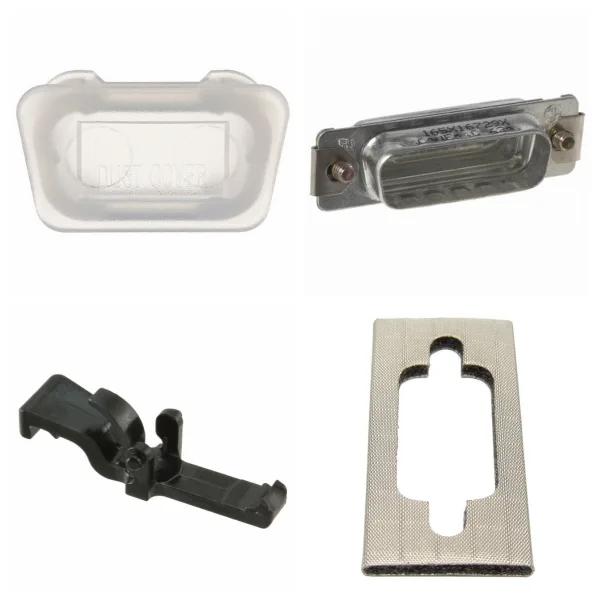
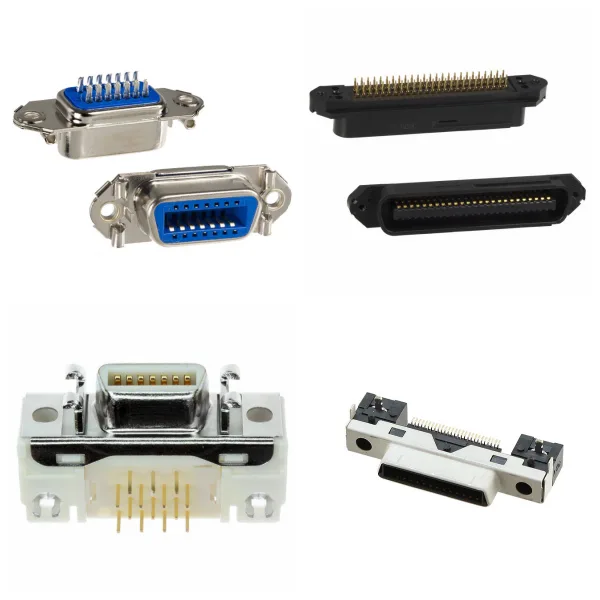
D-Sub, D-Shaped Connectors
D-Sub (D-shaped) connector is a classic electronic interconnection solution, and its name comes from the unique D-shaped metal shield profile.
1. D-Sub, D-Shaped Connectors Overview
Full Name: D-Subminiature Connector, first created by ITT Cannon in the United States in the 1950s.
Appearance Features: The shell is in the shape of the letter “D”, and the mechanical anti-misinsertion function is achieved through asymmetric design.
2. What is the Core Structure of D-Sub, D-Shaped Connectors?
Shell Material: The metal shell provides electromagnetic shielding and mechanical protection, and some models use plastic shells to reduce costs.
Contact Design: It includes two types: male head (pins) and female head (holes), supporting differential signal transmission to reduce electromagnetic interference.
Pin Density: It was known for its ultra-small size in the early days, and now high-density models have been developed to meet complex wiring needs.
3. Technology Evolution of D-Sub, D-Shaped Connectors
First Generation (1960s)
The double-layer protection structure (metal shell + plastic body) adapts to the harsh environment of aviation and military fields.
Second Generation (mid-1980s)
Stamping technology replaced lathe processing, significantly reducing manufacturing costs and promoting the popularization of computer peripherals.
Third Generation (1990s to Present)
The simplified structure is a single-layer shell, and the models are expanded to DA/DB/DC series to meet the needs of industrial control and medical equipment.
4. Specifications and Applications of D-Sub, D-Shaped Connectors
|
Category |
Typical Specifications |
Main Application Scenarios |
|
Standard |
9-pin, 15-pin, 25-pin |
RS-232 serial port, VGA video interface |
|
High-density |
37-pin and above |
Industrial automation, high-speed data transmission |
|
Hybrid |
High-low frequency composite design |
Aerospace equipment, precision instruments |
5. What are the Key Advantages of D-Sub, D-Shaped Connectors?
Stability: Gold-plated contacts and a multi-point grounding design ensure signal integrity.
Compatibility: Standardized interfaces support cross-generation device interconnection.
Durability: It can withstand more than 500 plug-in and unplug cycles, suitable for frequent maintenance scenarios.
With its modular design, this connector continues to play a key role in industrial control, medical equipment, and communication infrastructure.
6. D-Sub, D-Shaped Connectors FAQs
1) What is the origin of the name D-Sub?
D-Sub stands for “D-Subminiature” and is named for its unique D-shaped shielding cover design. In the early days, it was called an “ultra-miniature” connector because of its miniaturization. Although the volume advantage is no longer prominent, the D-shaped structure still effectively prevents mis-insertion.
2) What are the main application areas of D-Sub connectors?
Computer and Communication Equipment: such as VGA interface, serial port;
Industrial and Military: vibration-resistant design is suitable for aerospace and defense equipment;
Power and Signal Transmission: supports analog, digital, and power signals.
3) What is the difference between high-density D-Sub and standard D-Sub?
High-density D-Sub increases the pin density under the same shell size (such as DB25 shell can accommodate a higher number of pins), which is suitable for compact space requirements, while the standard version has a sparser pin arrangement.
4) How does D-Sub achieve electromagnetic interference (EMI) protection?
Through metal shell shielding and additional EMI filtering design (such as a Pi-type adapter), it is suitable for sensitive electronic environments.
5) What are the typical installation methods of D-Sub connectors?
Board End Installation: welding or direct plug-in PCB installation;
Cable Assembly: injection molding (non-removable) and assembly (removable metal/plastic back shell);
Screw Fixing: ensure a stable connection to prevent accidental detachment.
6) What are the special uses of combined D-Sub connectors?
Combined D-Sub integrates different types of interfaces (such as power + signal) in the same shell, reducing the complexity of the wiring harness and reducing the risk of signal interference.
7) What scenarios are micro D-Sub (Micro-D) suitable for?
Designed for extreme environments (such as aerospace equipment), it is smaller and has a wide temperature range (-55°C to 125°C), suitable for high-density electronic devices.
8) How does the material selection of the D-Sub connector affect its performance?
Metal Housing: Improves shielding and mechanical strength;
Lightweight Aluminum Backshell: For aerospace scenarios where weight reduction is required;
Plastic Insulator: Balances cost and basic protection needs.
9) How is the maintenance and reliability of D-Sub connectors?
The pin and socket contact design supports on-site repairs, and the metal structure ensures long life (especially in vibration environments). Some models have a protection level of IP68 and are suitable for humid or dusty environments.
PARTS, BOM OR COMPLETE PCBA
Request your component or BOM quote.
Tell us whether you need parts only or a finished PCB assembly. Availability, price, order quantity and delivery are confirmed for your specific request.
- Exact manufacturer part numbers and manufacturers
- Required quantity, target date and shipping destination
- BOM file and quantity per board for a complete build
- Approved alternatives and any parts that must not be substituted
- For turnkey PCBA: PCB files, placement data and test requirements
Proposed substitutions need your approval. Tell us about traceability, documentation or packaging requirements before purchasing is agreed.
Files are optional for an initial discussion. You can send the BOM by email if the uploader does not accept your file. An inquiry does not authorize purchasing or production.
Start with your requirements.
Email is required. Add “components only” or “full turnkey PCBA” in the service field.
