
|
Images
|
Mfr.Part #
|
In Stock
|
Manufacturer
|
Description
|
Package
|
|---|---|---|---|---|---|

|
D41S61A | 7849 | Altech Corporation | RECPF20A3P4W12H120250V ORANGEIP4 | Bulk |
|
|
D51S70A | 7717 | Altech Corporation | RECPF20A4P5W5H347600V BLKIP44LAR | Bulk |
|
|
1301410087 | 7782 | Molex | SUPER-SAFEWAY PLUG NEMA L5-15 BL | Bulk |
|
|
1301440061 | 17747 | Molex | 6-20 PLUG HI-IMPACT | Bulk |
|
|
1301440065 | 31563 | Molex | PWR ENT PLUG NEMA6-15 STR SCREW | Bulk |
|
|
A52S51A | 7742 | Altech Corporation | INLTM30A4P5W7H277480V RED IP44AN | Bulk |
|
|
D41S20A | 12049 | Altech Corporation | RECPF20A3P4W9H250V BLUEIP44LARGE | Bulk |
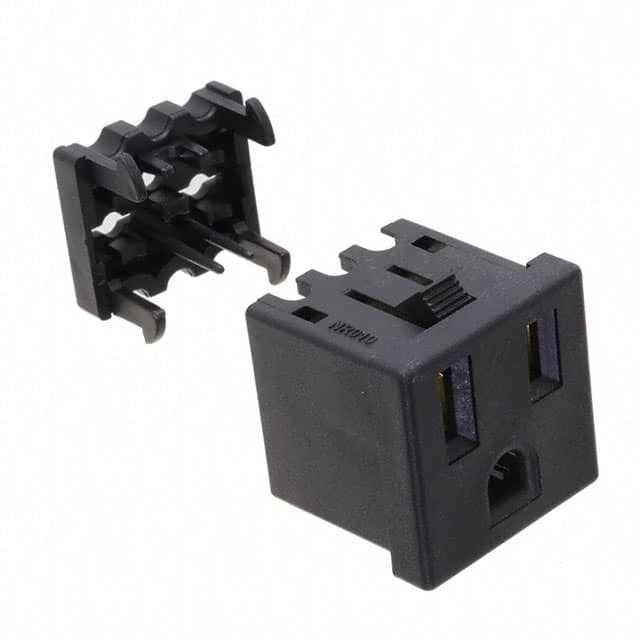
|
3-119-049 | 3294 | SCHURTER Inc. | NEMA 5-15R IDC | Bulk |
|
|
D41S21A | 13477 | Altech Corporation | RECPF20A3P4W9H250V BLUEIP44SMALL | Bulk |
|
|
1301450022 | 28969 | Molex | HI-AMP TURNEX L21-20 PLUG 4P5W | Bulk |

Plugs and Receptacles
As the “bridge” of electronic systems, the reliability of plugs and receptacles directly affects the performance of equipment. Its modular design supports rapid maintenance and upgrades and is an indispensable basic component in the electronics industry.
Plugs and Receptacles Overview
1) Basic Concept
Plug: refers to a connector component with a raised contact end, which is used to insert into the corresponding interface to complete the circuit conduction.
Receptacle: refers to a connector component with a grooved contact end, which is used to receive the plug and establish an electrical connection.
The two together constitute a separable interface to achieve the transmission of current or signals between devices and are easy to assemble and maintain.
2) Structural Features
Contact Body: The male seat usually uses a pin (positive contact body), and the female seat uses a jack or a tuning fork reed (negative contact body), and the circuit is connected and disconnected by plugging and unplugging.
Insulator and Shell: The shell material must be corrosion-resistant, and the internal insulator prevents short circuits; some designs add waterproof structures such as rubber sealing rings (such as waterproof connectors).
What are the Core Performance Requirements of Plugs and Receptacles?
1) Mechanical Performance
The plugging and unplugging force needs to balance the convenience of operation and the stability of connection (such as low plugging and unplugging force design LIF/ZIF);
The mechanical life needs to meet the performance after multiple plugging and unplugging without significant performance degradation.
2) Electrical Performance
The contact resistance needs to be as low as milliohms, and the insulation resistance needs to reach hundreds of megohms;
The withstand voltage strength needs to meet the requirements of the equipment working environment.
3) Environmental Adaptability
The operating temperature range is usually -55℃ to 125℃, and it needs to withstand humidity, salt spray, and vibration shock.
What are Plugs and Receptacles Used for?
1) General Scenarios
Used for power supply, signal line interface (such as USB, HDMI, RJ45), and board-to-board connection.
2) Special Scenarios
Waterproof connectors are suitable for humid environments such as outdoor lamps and electric vehicles, and IP rating certification is passed to ensure protection performance.
What are the Types of Plugs and Receptacles?
1) Classification by Appearance
Circular (such as aviation plug), rectangular (such as D-SUB), snap-on (such as BNC RF connector), etc.
2)Classification by Function
Signal transmission type (focusing on high-frequency characteristics), high current type (focusing on current carrying capacity), etc.
Plugs and Receptacles FAQs
1)Can power strips be used for fixed wiring for a long time?
No. UL 1363 clearly limits RPTs to temporary power extensions only and cannot replace building fixed wiring.
2)Are all connectors subject to the same standard?
No. The testing requirements for plugs and sockets (UL 498/1363) and data connectors (UL 1977) are completely different.
