
ORINEWPCB · COMPONENTS & TURNKEY PCBA
AC Power Connectors — Component Sourcing
Browse AC Power Connectors and send the exact manufacturer part number, required quantity and target date. For a complete board build, include your BOM and PCB files in a turnkey PCBA request.
Catalog entries and category counts do not confirm stock or delivery. Availability, pricing and any proposed alternatives are reviewed for your request.
One part number or a complete BOM?
For individual parts, send the exact manufacturer part number, manufacturer, quantity and required date. For a BOM, include part numbers, quantities per board, reference designators and any approved alternatives.
Need the components assembled?
Keep the board files and BOM on one revision. Request PCB fabrication, sourcing and assembly together, with programming or functional testing defined for your build.
Browse component categories.
Cannot find your part in the directory? Send the full part number or your BOM for review.
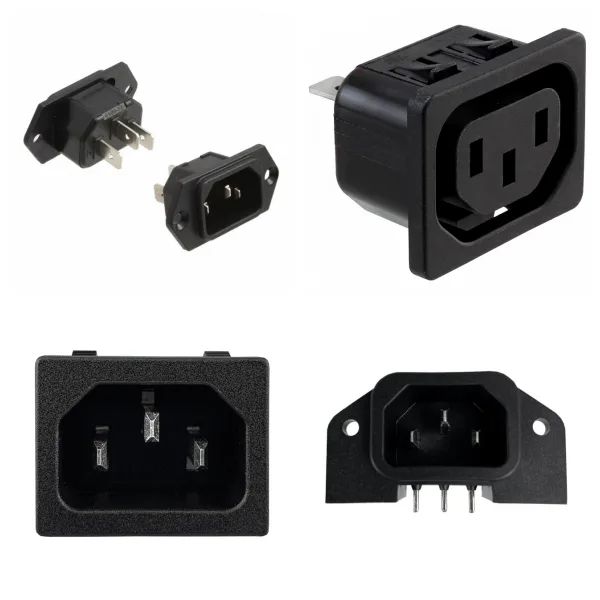
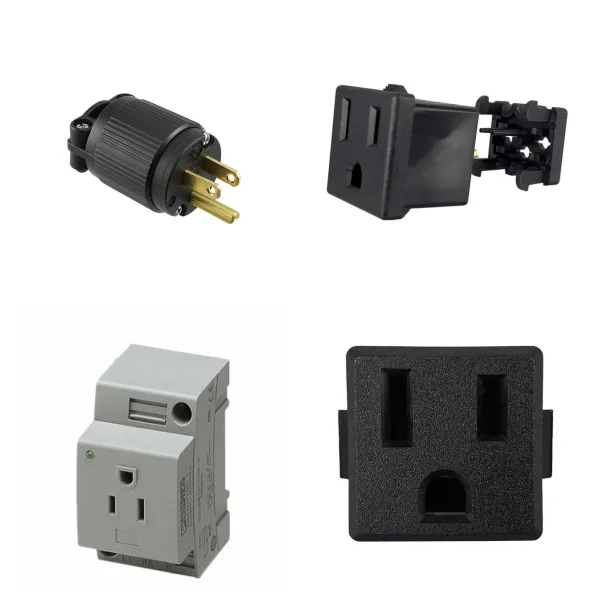
AC Power Connectors
AC power connector is an interface device for transmitting alternating current. The direction and magnitude of the current change periodically over time. The waveform is usually a sine curve with a frequency of 50Hz or 60Hz. It is mainly responsible for making a safe and stable electrical connection between the power supply and the device. Common types include two-hole, three-hole, and five-hole sockets, which are widely used in home, industrial, and outdoor scenes.
1. What is the Basic Structure of AC Power Connectors?
Contact Parts: responsible for conducting electricity, usually made of copper alloy, ensuring low resistance and high current carrying capacity.
Insulator: isolates contacts of different polarities, and usually uses plastic or ceramic materials to ensure electrical safety.
Casing: provides mechanical protection and fixing functions, and the materials include metal (high-temperature resistance) or engineering plastic (lightweight).
2. What are the Types of AC Power Connectors?
1) By Voltage/Current Level:
Low voltage type (≤250V): suitable for small devices such as home appliances and computers.
High voltage type (>250V): used in high-power scenes such as industrial equipment and medical instruments.
2) By Connection Form:
Plug-in type: Commonly used in household appliances, easy to plug and unplug quickly (such as IEC 60320 standard interface).
Fixed type: Used in industrial equipment, fixed by screws or welding to enhance reliability.
3) By Application Standard:
International Standard: Such as IEC 60320 in Europe and NEMA series in the United States.
Chinese Standard: GB/T series, adapted to domestic voltage and socket specifications.
3. What are the Key Performance Parameters of AC Power Connectors?
1) Electrical Performance:
Rated Voltage/Current: Common 220V/10A or 110V/16A, need to match equipment requirements.
Insulation Resistance: Usually requires ≥100MΩ to prevent leakage risks.
2) Mechanical Properties:
Plug-in Life: High-quality connectors can withstand thousands of plug-ins (such as IEC standards up to 5000 times).
Contact Retention: Ensure stable contact after plugging and avoid looseness and power failure.
3) Environmental Adaptability:
Temperature Range: -55℃~125℃, suitable for different working environments.
Protection Level: Some models support IP67/IP68 dust and water resistance, suitable for outdoor or humid environments.
4. What are AC Power Connectors Used for?
Consumer Electronics: Such as power interfaces of TVs, speakers, and laptops.
Industrial Equipment: High-voltage power supply systems of electric forklifts, medical instruments, and communication base stations.
New Energy Field: Power transmission of solar inverters and electric vehicle charging piles.
5. Selection Recommendations for AC Power Connectors
Matching Standards: Prioritize electrical standards that meet the location of the equipment (such as IEC, NEMA, or GB/T).
Material Selection: Metal casings are recommended for high-current scenarios to enhance heat dissipation and mechanical strength.
Certification Requirements: Pay attention to safety certifications such as UL and CE to ensure product compliance.
Through reasonable selection and standardized installation, AC power connectors can significantly improve the power supply safety and operating stability of the equipment and are an indispensable basic component in electrical systems.
6. AC Power Connectors FAQs
1) What is the difference between AC and DC power connectors?
AC (Alternating Current): Voltage changes periodically (e.g. 220V/50Hz), suitable for long-distance power transmission and most household appliances (e.g. refrigerators, TVs, etc.).
DC (Direct Current): Current direction is constant, common in chargers, and electronic devices (e.g. mobile phones, laptops).
Marking Differences: AC sockets usually indicate voltage and current limits (e.g. 250V 10A), while DC sockets are common in low-voltage devices.
2) What are the rated parameters of AC power connectors?
Voltage: The mainstream is 220V (110V in some countries/regions).
Current: 10A or 16A is commonly used, and exceeding the rated value may cause fire risks.
Temperature Range: Some industrial-grade sockets support -40℃ to 85℃ environments.
3) What are the materials and production processes of AC power connectors?
Material: The shell is mostly made of plastic (lightweight, insulating) or metal (durable, pressure-resistant), and the contact parts use copper alloy to reduce resistance.
Process: Injection molding (shell), stamping (conductive parts), and casting (metal shell) are the mainstream technologies.
Protection Performance: High-end sockets have IP dust and water resistance ratings and are suitable for outdoor or industrial environments.
4) How to use AC power connectors safely?
Avoid Overload: Make sure that the power of the appliance does not exceed the current limit of the socket (such as a 10A socket corresponding to ≤2200W equipment).
Grounding Protection: Three-hole sockets reduce the risk of leakage through the grounding wire.
Regular Inspection: Plugs/sockets that are worn or have poor contact need to be replaced in time.
PARTS, BOM OR COMPLETE PCBA
Request your component or BOM quote.
Tell us whether you need parts only or a finished PCB assembly. Availability, price, order quantity and delivery are confirmed for your specific request.
- Exact manufacturer part numbers and manufacturers
- Required quantity, target date and shipping destination
- BOM file and quantity per board for a complete build
- Approved alternatives and any parts that must not be substituted
- For turnkey PCBA: PCB files, placement data and test requirements
Proposed substitutions need your approval. Tell us about traceability, documentation or packaging requirements before purchasing is agreed.
Files are optional for an initial discussion. You can send the BOM by email if the uploader does not accept your file. An inquiry does not authorize purchasing or production.
Start with your requirements.
Email is required. Add “components only” or “full turnkey PCBA” in the service field.
